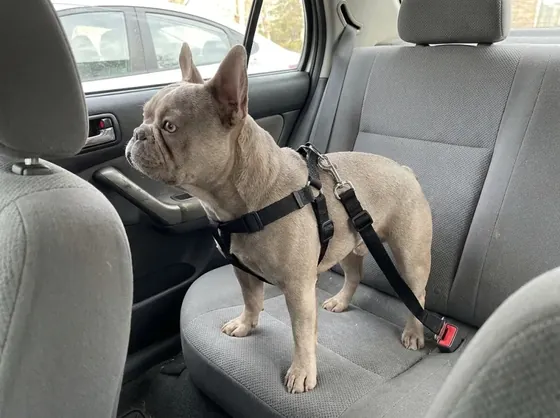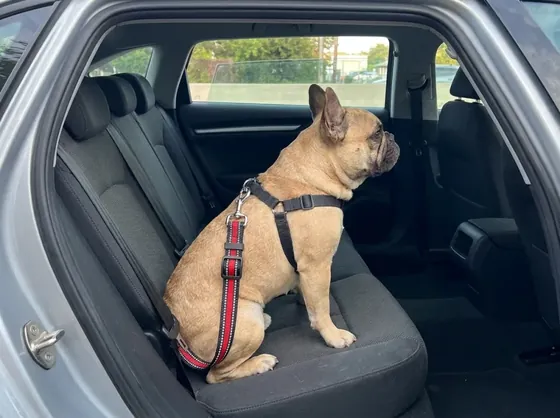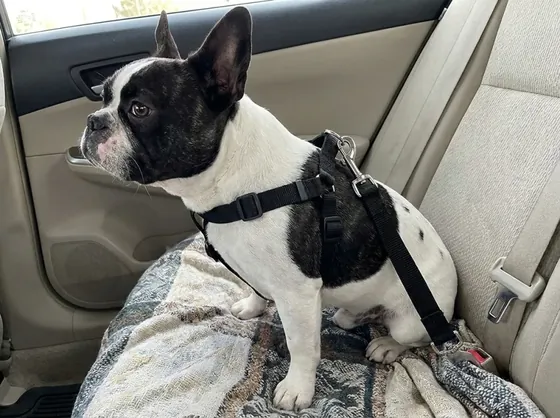
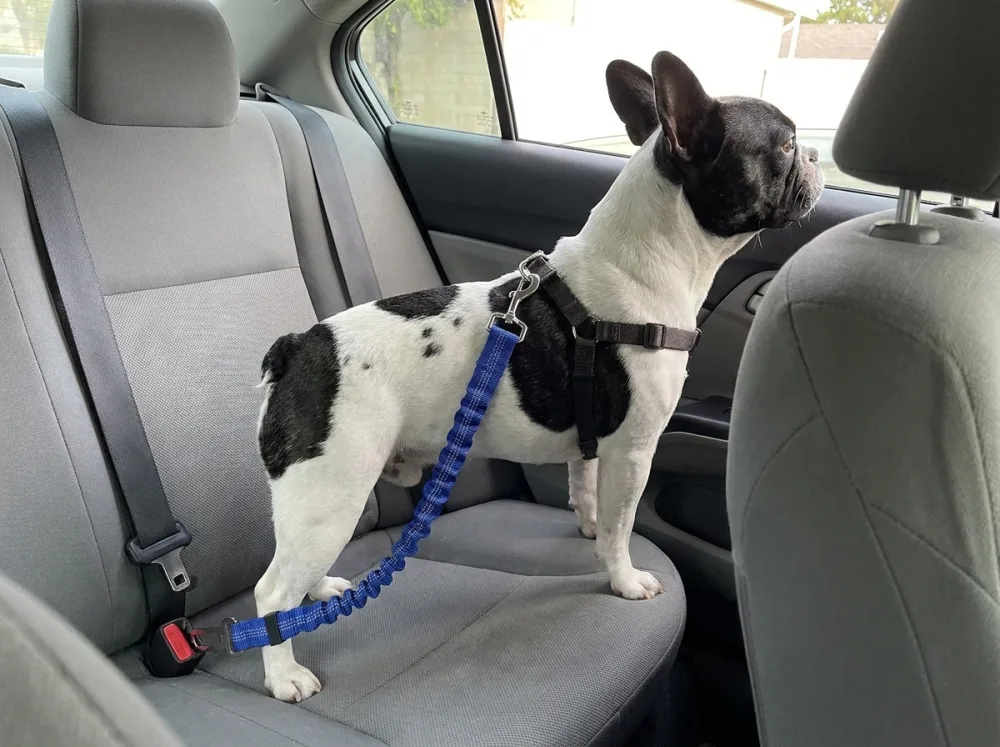
Look at the pied dog in our photo. He stands on the back seat with his nose at the window. His black harness has a metal ring at the shoulders, and a blue strap runs from that ring down to the seat belt buckle behind his hips. Much of it is bunched up like the top of a sock.
That bunched part is the elastic. It is the whole reason this tether exists.
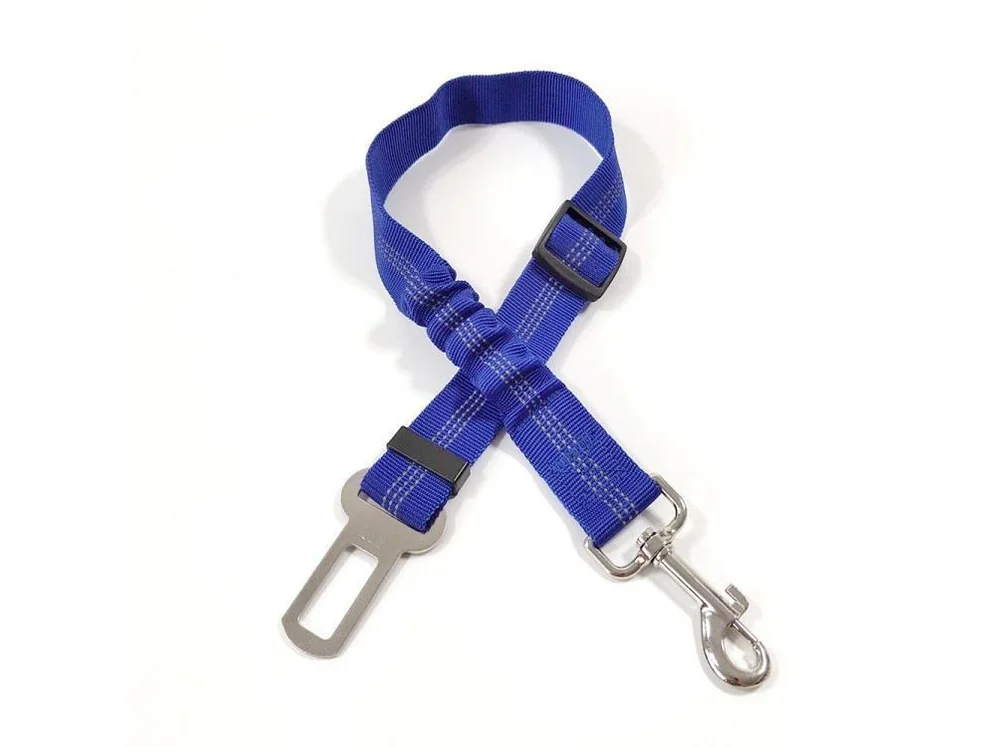
The rest is what every car tether has. A flat metal tongue clicks into the seat belt buckle at one end. A swivel snap hook clips to the ring on his harness at the other. A slide buckle in between sets the length.
It is not a harness. It has no chest strap and no neck strap, so on its own it holds nothing. It joins a harness he already wears to the car.
Here’s what that means for you. You choose the harness for how it fits him. You choose this for what happens between the harness and the buckle.
Here are the measures in one place.
| Measure | On this tether |
|---|---|
| Length, adjustable | 47–70 cm (18.5–27.6 in) |
| Strap width | 2.5 cm (1 in) |
| Weight | About 74 g (2.6 oz) |
| Webbing | Nylon |
| Metal parts | Zinc alloy |
| Length adjuster | Plastic slide buckle |
| Hook | Swivel snap hook with spring gate |
| Stretchy section | One, in the strap |
| Reflective thread | Three dashed lines along the strap |
| Colors | Six |
The strap is 2.5 centimeters wide, the same as the three other car belts in our shop.
At the buckle end, a small black plastic keeper sits beside the tongue. At the other end, the hook hangs from a metal loop through the webbing. Along the strap sits the slide buckle, also black plastic. Pull the strap through it to make the tether shorter or longer.
Three dashed lines of reflective thread run down the webbing and carry on over the stretchy part. Headlights or a flashlight make them show.
The hook swivels. A Frenchie who circles before he lies down turns the hook, and the strap stays flat.
Spin the hook with your finger when it arrives. It should turn freely, and the spring gate should snap shut on its own.
The reflective thread is the same on all six colors.
Start with the seat, not the dog. Sit him where he will ride. Hold a tape from the seat belt buckle to the ring on his harness. Lay it the way the strap will run: along the seat, then up to the ring. That number decides which of our belts fits your car.
Your harness needs a ring on his back for this. Without one the hook has nothing to grab.
| Buckle to ring, sitting | Take |
|---|---|
| Under 47 cm | Soft Car Belt, which goes down to 38 cm and has no stretch |
| 47–70 cm | This tether |
| Over 70 cm | Reflective Car Belt, which goes up to 90 cm |
A very small puppy on a wide back seat may still have slack at 47 centimeters, and the stretch comes on top. If that is your dog, take the tape to the seat before you order, not after.
The number is for the setup you will use. It is not a promise that he will stay put on any setting, so the next section is about the setting.
In our photos the buckle sits low in the crease of the seat and the ring sits high on his back, so the strap slants between them. The stretchy part is bunched, not pulled long. That is the setting to copy.
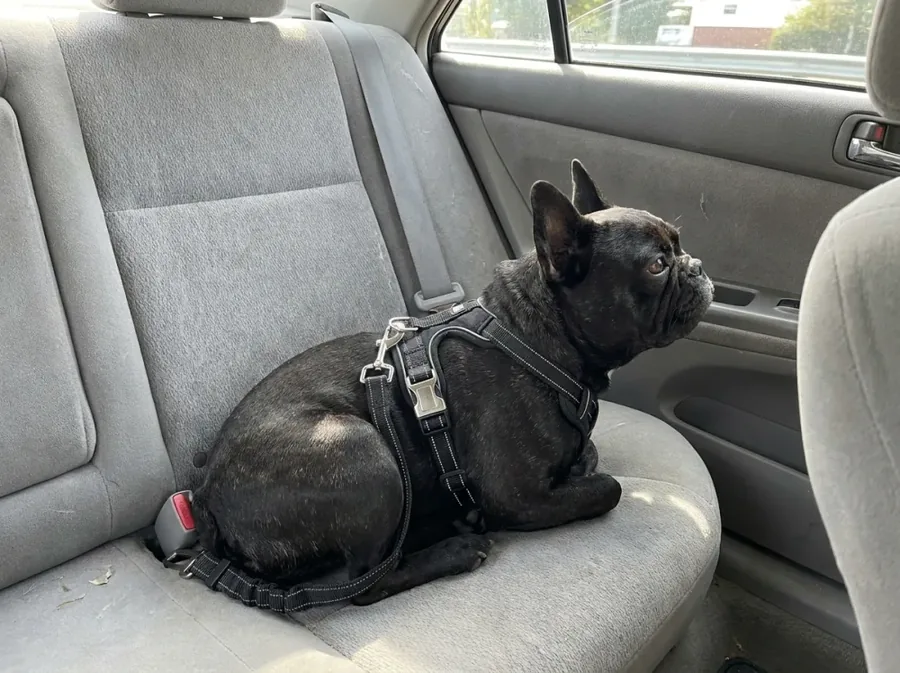
Look at the black dog. He is curled into a ball, and his strap lies across his side in one shallow curve. That curve is what lying down costs. Any more is extra reach.
Now shorten the strap until nothing hangs past that. A loop is slack, and slack is distance he can travel before the strap pulls tight. The elastic adds more on top.
Here’s the order that works. Click the tongue into the buckle first. Lift him in, clip the hook to his ring, and give the hook one tug to check the gate is shut.
Then a quick test. Pull the stretchy part with your hand. Whatever extra you draw out is extra reach for him.
So set it short enough that he can sit, stand and lie down, and no longer. If he can put his front paws on the back of the front seat, it is too long.
A plain strap has one setting. He turns to watch a squirrel on the curb and the strap is either loose or tight. When he lunges, it stops him dead against the harness.
The elastic section changes that. It gives a little when he shifts and more when he lunges, and then it draws back in. What he feels at the ring is a slower pull than a plain strap would give.
That is what it does. Here is what it does not do.
It does not make a crash safer. The same give that softens a lunge lets him travel farther in a hard stop than a fixed strap would. This tether has no crash rating, and we do not claim one.
So the elastic is for ordinary drives. It suits the dog who shifts on the seat, the one who jumps up at every bus, and the one who does not like being held still.
It does nothing for a dog who is asleep before the end of your street. If that is yours, a plain belt does the same job.
The puppy comes home on Saturday. You need no measure of him for this tether, only for his harness. What you need is the distance from the buckle to the spot where he will lie. Put the harness on at home first, wear it around the house, and keep the first drives short and dull.
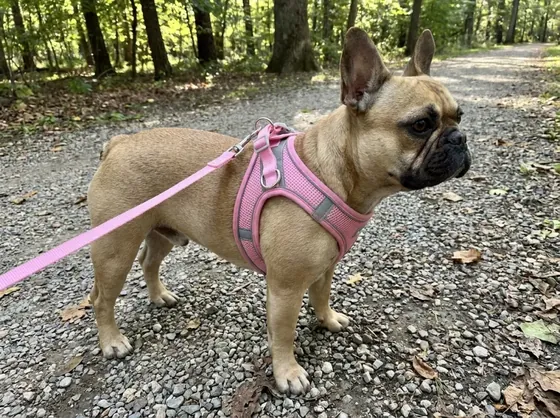
The puller yanks at every corner on a walk, and at the window in the car. This tether will not change that, and it never goes on a walk. The tongue is made for a buckle, not a sidewalk. In the car the hook goes on the back ring, and the front ring stays for steering on a walk.
The third dog hates his harness going on. He plants his feet and will not move.
Have that argument at home in the hallway, where you have time. Then carry him to the car with the harness already on, and clip the tether after he sits. It never touches his head or his neck, so it adds nothing to the fight.
Here is who should not buy this tether.
If you want the shortest possible reach, take a belt with no stretch. Our Soft Car Belt is plain webbing that sets from 38 to 62 centimeters. It has no stretchy section, and that is the point of it.
Here is how the four car belts compare.
| Belt | Length | What sets it apart |
|---|---|---|
| This tether | 47–70 cm | Stretchy section, swivel hook, reflective thread |
| Frenchie Soft Car Belt | 38–62 cm | Plain webbing, no stretch |
| Frenchie Adjustable Car Tether | 45–66 cm | Swivel hook, plain webbing |
| Frenchie Reflective Car Belt | 54–90 cm | Reflective thread, longest reach |
If his harness is sold with a crash-test claim, adding any tether to it can cancel that claim. That is the warning from the Center for Pet Safety, a group that crash tests pet gear. Use that harness on its own, or ask its maker first.
If crash protection is what you are after, this is the wrong product. That group’s advice is a harness, crate or carrier that has passed a crash test, in the back seat.
The back seat is the only seat for this. Airbags can be dangerous for a dog in front. And a tether is for the drive, not for leaving him tied in a parked car. It is webbing, and a bored dog can chew webbing.
After the first drive, take the tether off and look at the elastic before anything else. It moves every time he does, so it wears first.
Pull it and let go. It should draw back into even folds. If it stays long, or you see loose threads or a gap where it is stitched to the webbing, stop using it.
Then check the rest. The tongue should click into the buckle and hold when you pull. The gate on the hook should snap shut by itself. The slide buckle should hold its place when you tug the strap. Do it again after the tenth drive.
The tether is only as good as the harness it clips to. Slide two fingers under the straps of his harness. If they do not fit, fix the harness before the next drive.
At the end of a drive, unclip the hook from his ring first, and hold on to it. If he was pulling, the elastic is stretched, and a hook you let go of swings back at the seat.
Six colors: black, red, blue, green, grey and light pink. Our photos show black on a black dog, blue on a pied dog and light pink on a cream one. Black on a dark seat is hard to spot at night. The dashed thread is what catches a flashlight.
Plan on 14 days. Your harness is pulled off the shelf, checked, packed and handed to the carrier — then it travels to you. When carriers are swamped, a busy week before Christmas or a storm across half the country, it can take a few days more.
Shipping is free on every order. No minimum and no handling fee, and duty and import tax are included too — the price you see is the price you pay, with nothing to settle at the door.
A tracking number appears on our tracking page the day your parcel leaves the warehouse. Before that there is nothing to track, so we show you the stage instead.
If day 14 passes and nothing has moved, email hello@frenchieharness.com with your order number. We will chase the carrier and tell you what we find.
You have 30 days from delivery to send an item back. It has to be unused and in the condition it arrived in, with the tags on.
Return postage is yours. We do not send a prepaid label. If we sent the wrong item or it arrived damaged, that one is on us — postage included.
Email hello@frenchieharness.com with your order number to start one. You get the return address by reply, usually the same working day. Do not send anything back before you have it.
Once your parcel reaches us we approve the refund within a working day or two; your bank then posts it back within 5–7 working days.
Reviews are for verified buyers only. Enter your order number so we can confirm your purchase.
Your review was received — we really appreciate you taking the time.
 Frenchie Harness