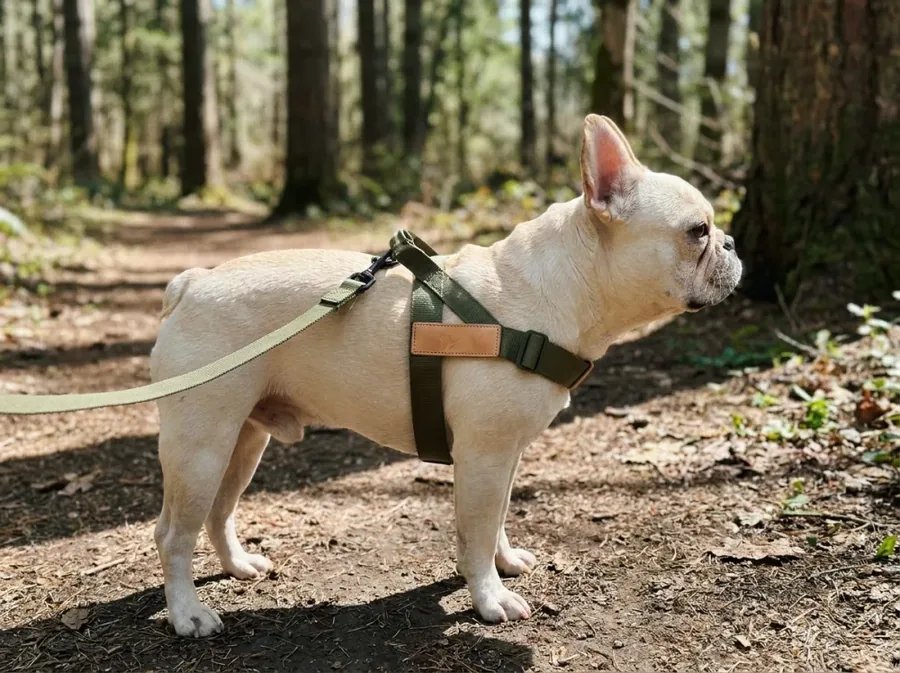
“Best fit and doesn’t go over the head (which my guy hates).” That is one Frenchie owner on Reddit, saying what he wants from a harness. This harness has no neck loop, so it does the second half of that sentence.
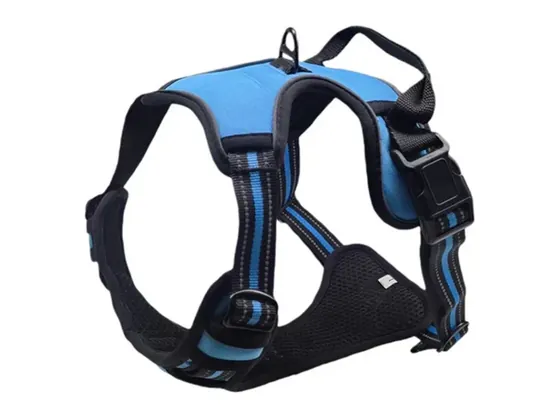
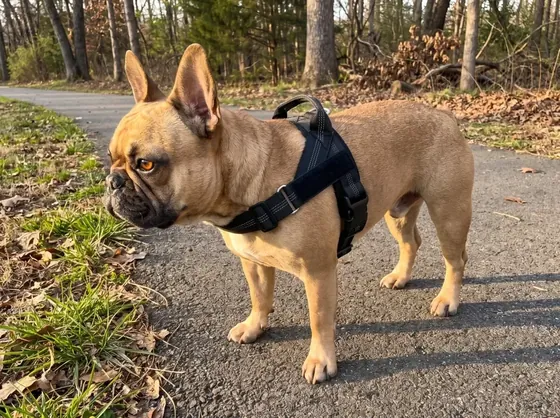
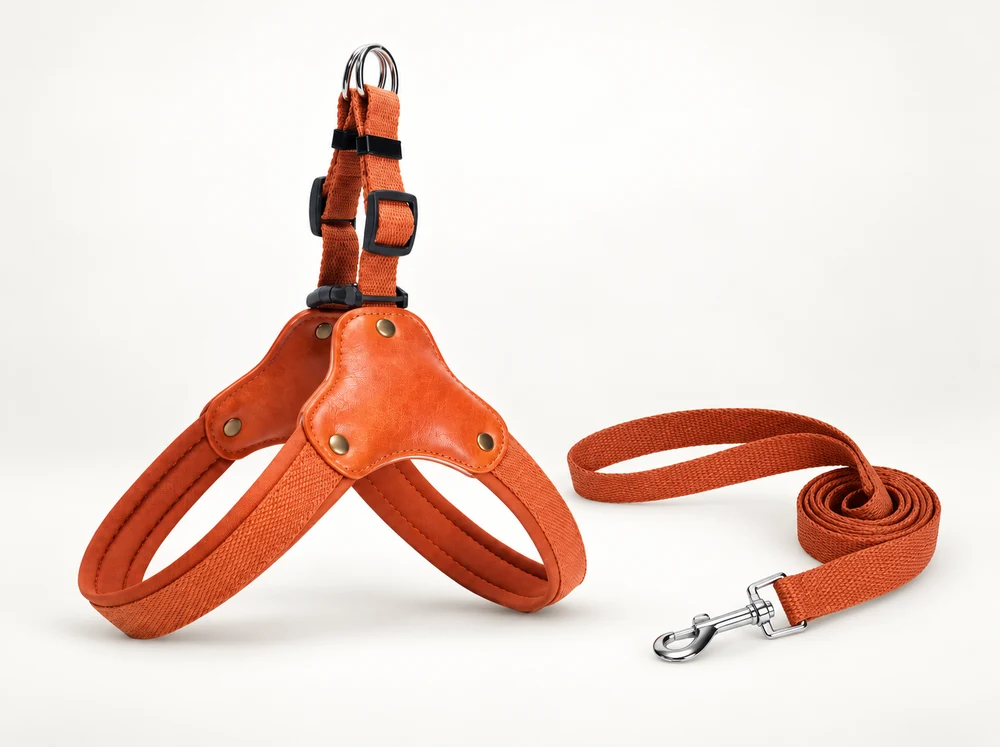
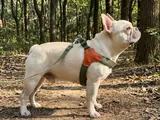
Lay it flat on the floor. It has two big padded openings, one for each front leg. He puts a paw in each, and one black buckle clicks shut on his back. His ears, his nose and his wide skull never come into it.
Here’s what is in the box.
| Part | What it is | Count |
|---|---|---|
| Openings | Wide padded loops with a woven-fabric face, one for each front leg | 2 |
| Plates | PU leather, riveted on, one on each side where the loop meets the back strap | 2 |
| Back strap | Flat woven strap with a slider that changes its length | 1 slider |
| Buckle | Black plastic side-release buckle at the top | 1 |
| Leash rings | Silver-colored metal rings at the top of the back strap | 2 |
| Leash | Flat woven strap in the harness color, hand loop at one end, silver-colored snap hook at the other | 1 |
It comes in four colors: army green, brown, black and red. The straps and the leash match. The plates are the same tan-brown on all four, so a black harness has a tan patch and a red one does too.
The name says leather patch. The material is PU leather. PU stands for polyurethane, a synthetic coating made to look like leather. It is not animal hide.
The plate sits on each side, where a padded loop meets the back strap. It is held down with rivets. On the four colors it gives the harness its one loud detail: tan-brown against olive, rust, black or red.
If you want real leather that softens over the years, this is not that harness. If you want the look, four colors and a leash in the box, it is.
The loops and the straps are woven fabric. The plates are the only leather-look part.
Owners keep asking the same thing: “sizing recommendations for a typical 25 lb frenchie?” Weight is only a starting point. A Frenchie is built with a wide chest, and the harness goes around the chest.
So measure it. Use a soft tape. Wrap it around his chest just behind the front legs, at the widest point. Slide two fingers flat under the tape. Read the number in centimeters and inches. That is the number to match.
The padded openings do not adjust. Only the back strap has a slider, and it changes the length of that strap, not the size of the openings. The chest number decides.
If he lands between two sizes, take the larger one. A roomy loop you can check with your fingers. A tight loop you cannot fix.
The size chart on this page gives chest ranges for S, M and L. Match your number to a row, not to a label.
No dog in the house yet? Wait. A tape on a real chest beats a guess from a breeder’s photo, and a puppy is easy to measure on his first day home.
Corner of the street. A squirrel on the left. Twenty-five pounds of Frenchie leans into the leash, and your shoulder finds out.
Here’s what this harness does about it. The leash clips to the two rings at the top of the back strap, and that is the only place it can clip. The pull runs straight back along his spine. Nothing turns his chest toward you.
What the design does give you is a clear neck. There is no strap across the front of his throat, because there is no neck loop at all.
It is a walking harness, not a training tool. If he drags you to every corner, look at our Front-Clip harness. It has a ring low on the chest panel, and a lunge turns his front end back toward you.
Stopping the pull is training work. No harness does it alone, and this one does not try.
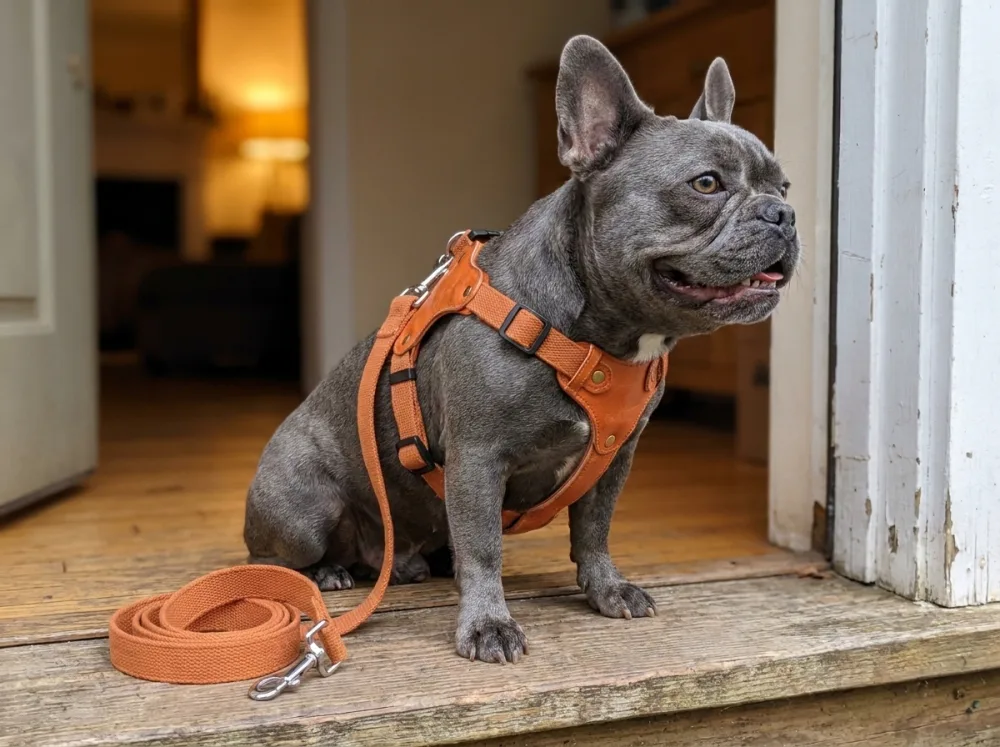
“Always causes chafing/redness under my pup’s armpits.” That is one owner’s line about a harness that did not work out. It is the reason this section exists.
On a step-in harness, the place to look is behind each front leg. The back edge of each loop sits there, and with every step it moves against the skin behind his elbow.
Here’s the check. After the first walk, take the harness off and run a finger along that spot on both sides. Look for hair pushed flat or damp, and for skin that looks a little pink. Do it again after the third walk. Do it once more after the tenth.
If the skin looks red or sore, stop using the harness and ask your vet.
A padded edge is not a promise. Every dog is built a little differently, and a loop that sits well on one chest can rub on another. If the loop feels snug behind the leg, the size is the first thing to look at.
The two-finger rule works here too. Slide two fingers flat under each loop. If they do not fit, it is too tight.
“She was just stubbornly sitting and wouldn’t move.” Some dogs do exactly this the first time a harness goes on. Don’t push. Here’s a plan that costs you three short sessions.
First — day one. Put the open harness on the floor next to his bed. Let him sniff it. Give him a treat when he does. Nothing goes on him.
Day two. Hold the loops open on the floor and treat him for putting a paw in. Close the buckle, treat, open it again. The whole thing takes about ten seconds.
Day three. Buckle it on indoors and leave it there while you make coffee, then take it off. Clip the leash on and walk him to the front door and back.
Then the first real walk. Keep it short and on his usual route, before you try somewhere new.
If he sits down and will not move, do not drag him. Stand still. Wait until he looks at you. Then use a treat to get one step, and one more.
This is where a harness with no neck loop helps. He has nothing to duck away from, and nothing goes past his face.
Before the harness goes on the dog, go over it once with your hands. It takes ten minutes and it saves an argument on the pavement.
Click the buckle shut three times and open it three times. It should click each time and hold when you pull on the two halves.
Slide the slider along the back strap and back again. Then pull the strap. It should stay where you left it.
Look at the rivets on each plate. They should sit flat. Tug the leash snap hook and check that the gate closes on its own.
Then hold the harness up next to his chest and compare the two openings with his front legs. If the loops look small for his legs, stop and measure again.
If anything looks wrong, do not put it on the dog.
You may be looking at three harnesses on this site. Here they are side by side, using only what is on each page.
| This harness | Y Step-In Harness | Front-Clip Harness | |
|---|---|---|---|
| Goes on | Front legs step in, one buckle on the back | Front legs step in, one buckle on the back | Over his head, a buckle on each side of the belly strap |
| Reflective | None | Tape on both straps, thread in the leash | Woven into the straps and around the chest panel |
| Leash in the box | Yes, in the harness color | Yes, 2 m rope | Yes, 1.5 m, in the matching color |
| Pick it when | Daytime walks, nothing over his head, you like the tan plate | The walk runs into dusk, or he needs a long lead | He leans into the leash |
Pick the Y Step-In harness when the walk runs into dusk. It has reflective tape, and this one has none. Pick the Front-Clip when he leans into the leash, because it has a ring low on the chest panel.
Pick this one when the walk is in daylight, nothing may go over his head, and you like a tan patch on olive, rust, black or red.
Here’s the short list of who should skip it. If he drags you down the street, buy the Front-Clip. This harness has one place for the leash, and that place is his back.
If most of your walks are after dark, buy one with reflective tape. This one has none.
If you want real leather, this is not it. The plate is PU leather.
If you need to lift him over a curb or into the car, buy the Grip-Handle harness. It has a molded handle on the back, and this one has no handle at all.
If his chest measures between two sizes, go up one. Do not squeeze a big chest into a small loop to save a size.
Plan on 14 days. Your harness is pulled off the shelf, checked, packed and handed to the carrier — then it travels to you. When carriers are swamped, a busy week before Christmas or a storm across half the country, it can take a few days more.
Shipping is free on every order. No minimum and no handling fee, and duty and import tax are included too — the price you see is the price you pay, with nothing to settle at the door.
A tracking number appears on our tracking page the day your parcel leaves the warehouse. Before that there is nothing to track, so we show you the stage instead.
If day 14 passes and nothing has moved, email hello@frenchieharness.com with your order number. We will chase the carrier and tell you what we find.
Measure the chest just behind the front legs. The Y front has no adjustment, so the chest figure decides it.
| Size | Chest | Fits |
|---|---|---|
| S | 34–46 cm / 13.4–18.1″ | Big puppies |
| M | 46–56 cm / 18.1–22.0″ | Most adult Frenchies |
| L | 56–66 cm / 22.0–26.0″ | Broad adults |
This harness comes in S, M and L, for a chest from 34 cm to 66 cm (13.4–26.0″). Under 34 cm, look at our Frenchie Puppy Harness, which starts at 32 cm (12.6″). Over 66 cm, take our Frenchie Saddle Harness, which goes up to 75 cm (29.5″).
Measure snug, straight off the tape. Do not add centimetres for slack — the chart already has it.
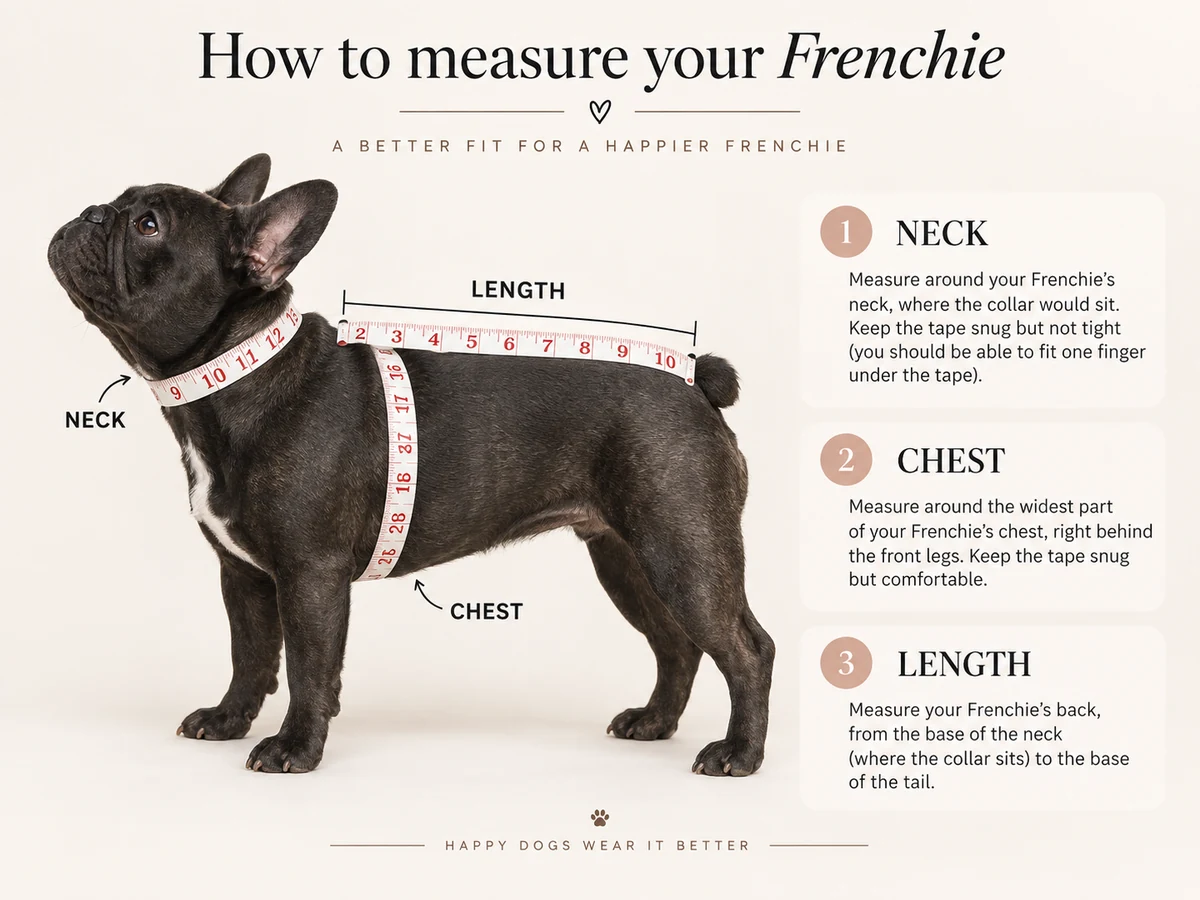
No tape at home? Use a shoelace, mark it, then hold it against a ruler. If his number falls in the gap between two sizes, take the larger one, because the smaller one stops short of him. If two sizes both cover his number, take the one where it sits farther from the edge of its range: that strap has room to tighten and to let out. If it sits exactly on the line where one size ends and the next begins, take the larger, because a harness can be taken in but not let out.
You have 30 days from delivery to send an item back. It has to be unused and in the condition it arrived in, with the tags on.
Return postage is yours. We do not send a prepaid label. If we sent the wrong item or it arrived damaged, that one is on us — postage included.
Email hello@frenchieharness.com with your order number to start one. You get the return address by reply, usually the same working day. Do not send anything back before you have it.
Once your parcel reaches us we approve the refund within a working day or two; your bank then posts it back within 5–7 working days.
Reviews are for verified buyers only. Enter your order number so we can confirm your purchase.
Your review was received — we really appreciate you taking the time.
 Frenchie Harness