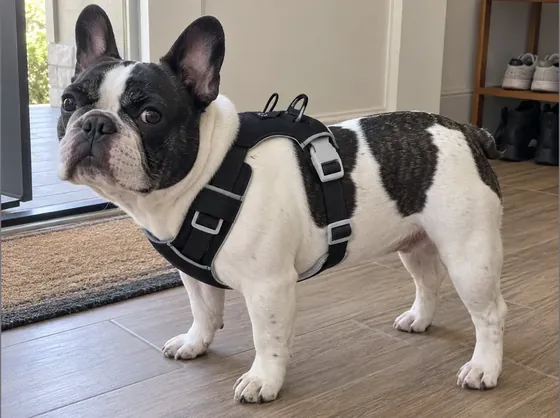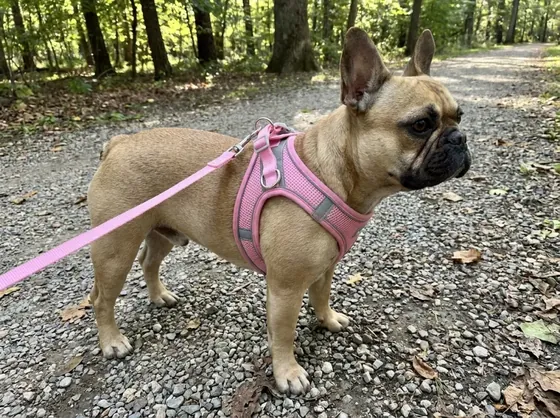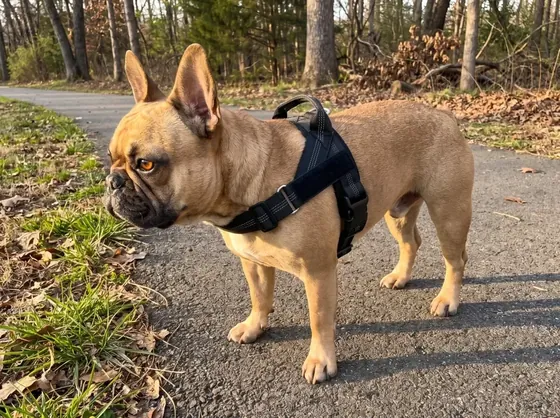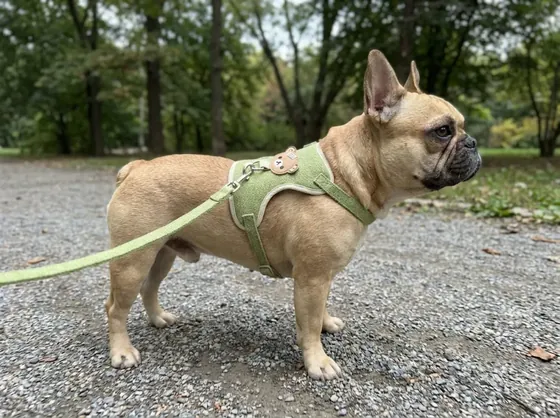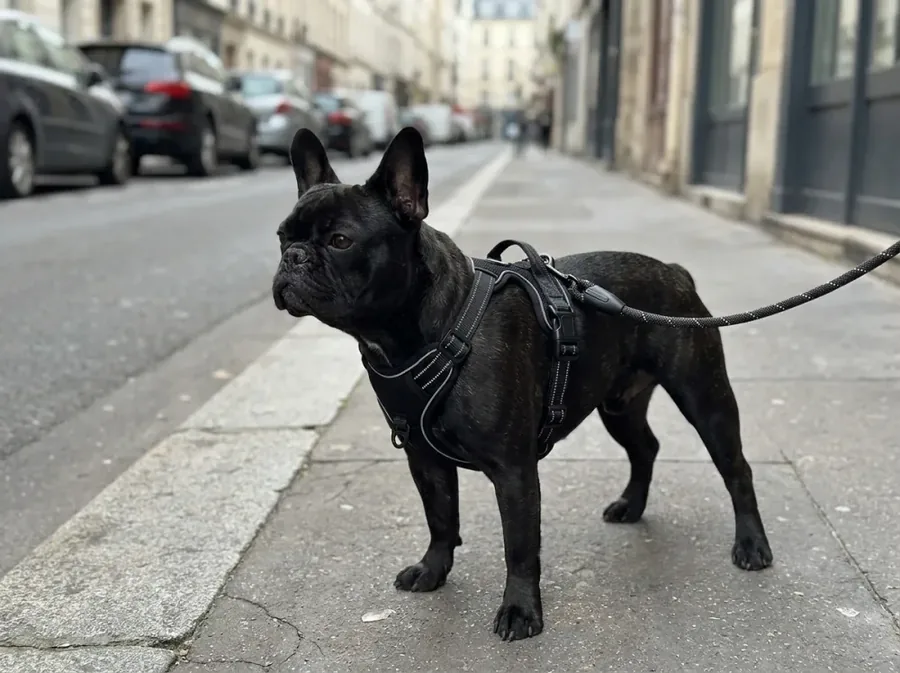
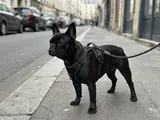
“If it has a front loop for your leash to clip onto, use it.” One owner gave that advice to another, in a thread about a Frenchie who pulls on his harness. This harness has the loop.
It is a front-clip harness for French Bulldogs: two leash rings, a wide chest panel and a 1.5 m leash in the box. It comes in two sizes, S and M, picked by weight.
Picture the curb at the end of your street. A squirrel bolts. Your Frenchie throws his whole chest into the leash. On the back ring, that lunge goes straight ahead and nothing turns him. On the chest ring, the same lunge swings his front end sideways, toward you.
Here’s what that does and does not do. It takes away his leverage. It does not teach him anything, and a strong dog can keep going. What changes the walk is you: stop when the leash goes tight, wait, and reward him for standing beside you.
| Ring | Where it sits | Clip the leash here when |
|---|---|---|
| Chest ring | Lower half of the chest panel | He leans into the leash |
| Back ring | On the back panel, at the base of the grab handle | He walks beside you on a slack leash |
Say the sidewalk is empty on Sunday morning and packed at 5 p.m. Use the back ring on Sunday. Move the clip to the chest ring when the crowd shows up. Same harness, same leash, one clip.
That is the point of two rings. A dog who pulls on Tuesday and heels on Wednesday does not need a second harness. He needs the clip in a different place.
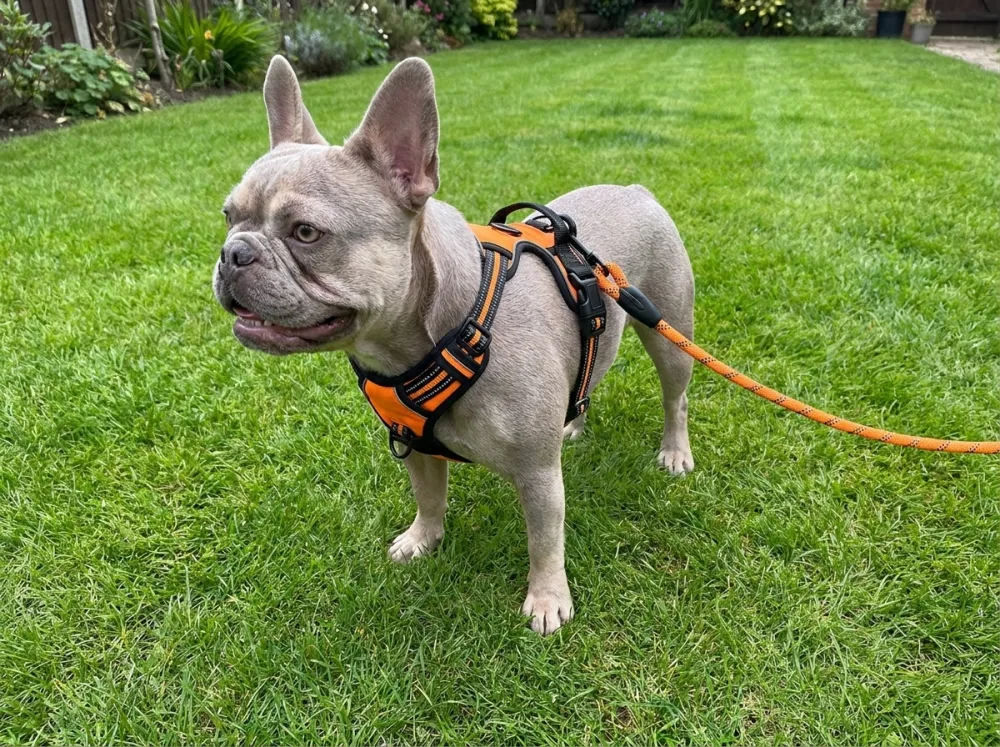
Laid flat, it is a wide chest panel, a smaller back panel with a handle, a padded neck loop and two belly straps. Here is each part.
| Part | What it is |
|---|---|
| Chest panel | Oxford cloth outside, a foam layer inside, mesh against his coat |
| Back panel | Holds the grab handle and the back ring |
| Chest ring | D-ring, zinc alloy, low on the chest panel |
| Back ring | D-ring, zinc alloy, at the base of the handle |
| Grab handle | Polyester webbing loop on the back panel |
| Neck loop | One closed padded loop, no buckle |
| Straps | Webbing with 3 mm reflective thread woven in, sliders on the shoulder straps and the belly straps |
| Reflective piping | Grey edge around the chest panel and the back panel |
| Buckles | Black side-release buckle on each side of the belly strap |
| Leash | 1.5 m (4.9 ft) nylon rope, foam-padded handle, metal snap hook |
| Colors | 6: black, red, sky blue, magenta, orange, neon green |
Only the belly strap opens. The neck loop is one closed ring with no buckle, so it goes over his head every time. If he is head-shy, read the section on who should skip this harness before you order.
A Frenchie is broad through the chest and short through the neck. A wide panel gives the leash a big flat surface to pull on, instead of a thin strap.
Two things reflect light: the grey piping around the panels and the thread in the straps. Neither glows on its own, and neither has a battery. They send a car’s headlight back toward the driver. At 6 a.m. in January he shows up as a bright outline instead of a dark shape. In daylight you see grey trim.
The grab handle is for holding, not lifting. Use it at a curb with a bus coming, or at the car door. In a doorway with a cyclist coming, one hand on the handle keeps him beside you while the other holds the leash. Do not carry him by it.
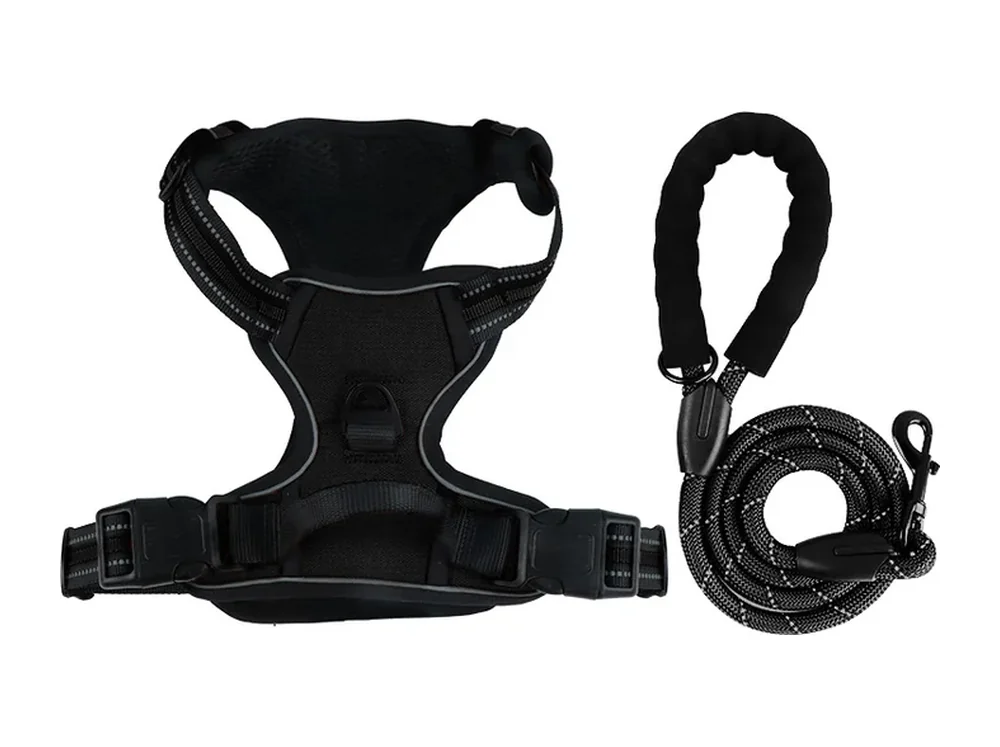
“I’m getting my first bulldog a week from now and making all my purchases now.” If that is you, there is no dog to measure yet. You have his weight from the breeder, and that is enough to start.
S is for 4 to 7.5 kg (8.8 to 16.5 lb). M is for 7.5 to 17.5 kg (16.5 to 38.6 lb). A 25 lb Frenchie weighs 11.3 kg, so he sits in the middle of M.
| Size | Dog’s weight | Chest strap adjusts to | Neck loop adjusts to |
|---|---|---|---|
| S | 4–7.5 kg / 8.8–16.5 lb | 34–63 cm / 13.4–24.8 in | 32–49 cm / 12.6–19.3 in |
| M | 7.5–17.5 kg / 16.5–38.6 lb | 38–75 cm / 15.0–29.5 in | 38–61 cm / 15.0–24.0 in |
The AKC breed standard sets the show limit at 28 lb (12.7 kg). S ends at 16.5 lb, so a grown Frenchie near that limit needs M. Under 4 kg (8.8 lb), he is outside S.
The two chest ranges overlap from 38 to 63 cm, so a 55 cm chest fits both on paper. That is why weight comes first. Near 7.5 kg, go by the tape, and if he lands between the two sizes, take the larger one.
Weigh him again before you reorder. The day he passes 7.5 kg, S is finished and M begins.
Measure him standing, on a floor he does not slip on, with a soft tape. For the chest, go around the widest part of his rib cage, just behind his front legs. Keep the tape flat and snug — do not add anything for slack.
For the neck, go around the base, where the loop will sit. A neck above 49 cm is outside S. A chest above 63 cm is too.
Open both belly buckles and loosen every strap before he is in the room. Hold the neck loop wide with both hands. Lower it over his head, past his ears, in one slow move. The wide panel should rest on his chest.
Reach under him and click each buckle shut, one side and then the other. Then set the sliders on the shoulder straps and the belly straps until two flat fingers slide under each one. Clip the leash on the ring you want.
Do not start with a walk. Lay the harness on the floor with a few treats around it and let him sniff. Then hold the neck loop open and feed him a treat through it, so his head goes in on its own.
Fasten it loosely for a few seconds, take it off, and reward him. Add a little time each day, in sessions of a few minutes. Walk in it only when he stands calmly with it on.
If he paws at it, freezes or backs away, go back one step. A dog who sits down and refuses to move on his first walk needs more time indoors first.
“Always causes chafing/redness under my pup’s armpits.” That line comes from a thread about another harness. The place to look is the same on any harness.
First walk. Before you leave, slide two flat fingers under the neck strap and under each side of the belly strap. Two fit. Three means loose, and a loose harness twists sideways when he leans. The chest panel should sit in the middle of his chest and stay there. Watch a few steps: his front legs should swing free.
Each strap has one place to be. The belly strap goes around his ribs, just behind his front legs, at the widest point: the spot where you measured. The neck loop sits at the base of his neck. Nothing should cross his throat, and no strap should sit in his armpit.
Tug the leash once on the chest ring. If the panel slides to one side, take up the belly straps.
Third walk. Lift a front leg and look at the strap behind it. It should sit behind the leg, not up in the hollow where the leg meets his body. Look at the fur there too. Flattened or rubbed hair is your cue to adjust the strap and look again the next day.
If the skin looks red or sore, stop using the harness and ask your vet.
Tenth walk. Sliders can shift with use. Check that the neck loop and the belly straps still take two fingers, and that the panel has not drifted. If it drifts, the strap usually needs bringing in, not a different harness.
A loose harness can be backed out of. Two fingers of room is the limit.
“Doesn’t go over the head (which my guy hates).” If that is your dog, this is the wrong harness. The neck loop is one closed ring and it goes over his head every time. A step-in harness closes behind the shoulders and never touches his head. We sell several.
Skip the chest ring, and maybe the harness, if he already walks on a slack leash. The back ring is enough for him.
A dog over 17.5 kg (38.6 lb) is outside M. A dog under 4 kg (8.8 lb) is outside S, and our puppy harness starts with an XS for a 32–37 cm chest.
And a front ring is not a cure. On any harness, a strong dog can keep going. If he has had sore skin under a harness before, ask your vet before you try another.
Here are four of our harnesses that people weigh against each other.
| Harness | Goes on | Leash rings | Sizes we carry |
|---|---|---|---|
| This front-clip harness | Over the head, a buckle on each side | Chest and back | S, M: 4–17.5 kg |
| Handle harness | Over the head, one buckle | Back only | S, M: 4–17.5 kg |
| Saddle harness | Over the head, a buckle on each side | Chest and back | S, M: 4–17.5 kg |
| Step-in harness | Front legs step in, one buckle on the back | Back for the leash; chest for a tag or light | M, L, XL: chest 34–58 cm |
The saddle harness is built the same way as this one, so choosing between them comes down to colors and the leash: 1.5 m here, and 1.2 m with the saddle’s S. The handle harness has one ring and no leash in the box. Take the step-in if the head is the problem.
The leash is a 1.5 m (4.9 ft) nylon rope with a foam-padded handle and a metal snap hook. The red and neon green ropes carry dark dashes. The black one carries grey.
The six colors are black, red, sky blue, magenta, orange and neon green. All six use the same size chart.
One thing before you order: 1.5 m is a long leash at a curb. Shorten it in your fist near traffic.
Plan on 14 days. Your harness is pulled off the shelf, checked, packed and handed to the carrier — then it travels to you. When carriers are swamped, a busy week before Christmas or a storm across half the country, it can take a few days more.
Shipping is free on every order. No minimum and no handling fee, and duty and import tax are included too — the price you see is the price you pay, with nothing to settle at the door.
A tracking number appears on our tracking page the day your parcel leaves the warehouse. Before that there is nothing to track, so we show you the stage instead.
If day 14 passes and nothing has moved, email hello@frenchieharness.com with your order number. We will chase the carrier and tell you what we find.
Weight picks the size on this one. Measure around the chest just behind the front legs as a cross-check, snug and straight off the tape — the range already allows for slack.
| Size | Weight |
|---|---|
| S | 4–7.5 kg / 8.8–16.5 lb |
| M | 7.5–17.5 kg / 16.5–38.6 lb |
We carry S and M. A 25 lb (11.3 kg) French Bulldog takes M.
Measure snug, straight off the tape. Do not add centimetres for slack — the chart already has it.
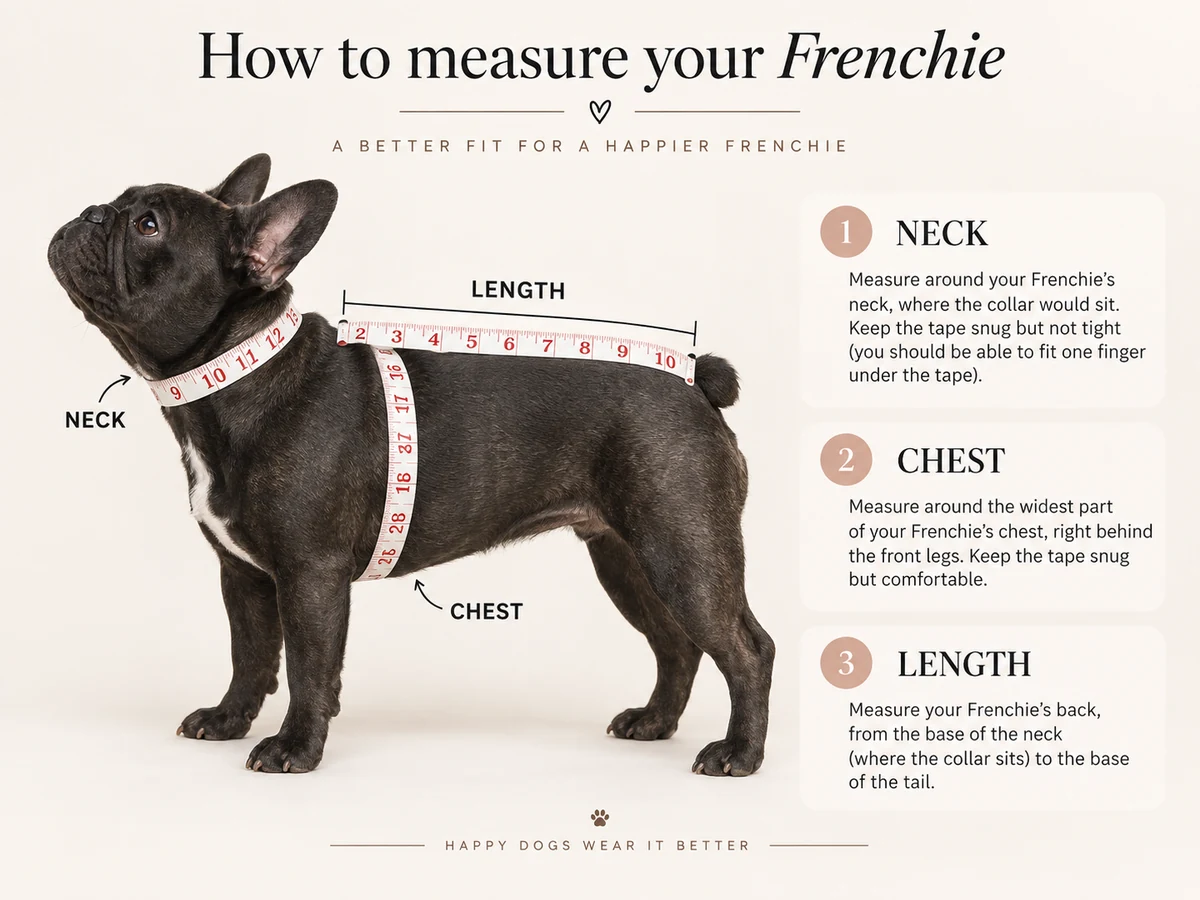
No tape at home? Use a shoelace, mark it, then hold it against a ruler. If his number falls in the gap between two sizes, take the larger one, because the smaller one stops short of him. If two sizes both cover his number, take the one where it sits farther from the edge of its range: that strap has room to tighten and to let out. If it sits exactly on the line where one size ends and the next begins, take the larger, because a harness can be taken in but not let out.
You have 30 days from delivery to send an item back. It has to be unused and in the condition it arrived in, with the tags on.
Return postage is yours. We do not send a prepaid label. If we sent the wrong item or it arrived damaged, that one is on us — postage included.
Email hello@frenchieharness.com with your order number to start one. You get the return address by reply, usually the same working day. Do not send anything back before you have it.
Once your parcel reaches us we approve the refund within a working day or two; your bank then posts it back within 5–7 working days.
Reviews are for verified buyers only. Enter your order number so we can confirm your purchase.
Your review was received — we really appreciate you taking the time.
 Frenchie Harness