“The harness tends to pull and twist to the side a lot… it’s adjusted as best as possible.” A Frenchie owner wrote that. Anyone who has fought a harness on a windy sidewalk knows the feeling.
Here’s why it happens. A Frenchie is wide in the chest and short in the body. A loose strap has nothing to hold it in the middle, so it slides toward whichever side the leash pulls.
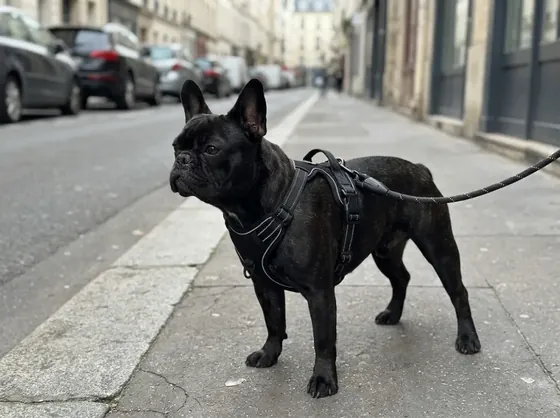
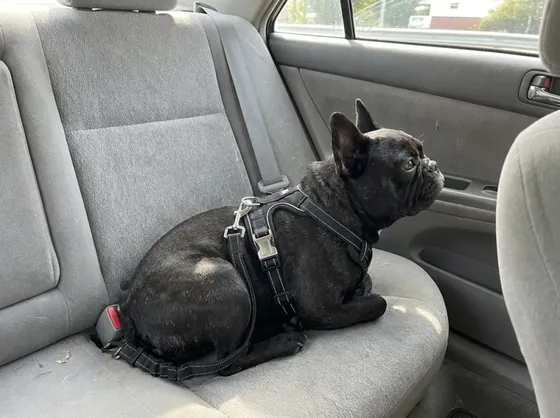
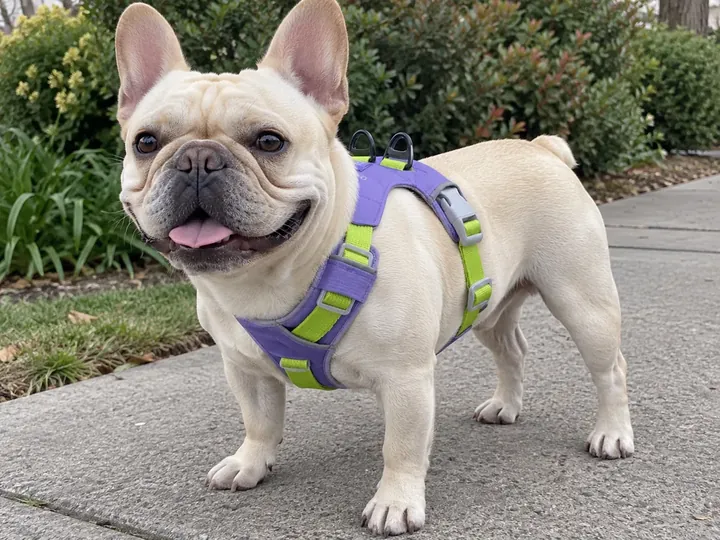
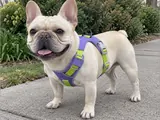
This one is built as a single piece. A Y-shaped panel lies on his chest and narrows as it runs down between his front legs. Two straps lead over his shoulders to a plate on his back. One buckle on his side closes it.
Putting it on takes three steps.
First, slip the neck opening over his head, so the panel lands on his chest. Second, close the buckle on his side and slide the straps until they sit snug. Third, clip the leash to the loop on his chest or the ring on his back.
There are no legs to lift and only one buckle to find. That helps on a dark morning, or with a dog who does not stand still.
One warning. A reader described a harness that “doesn’t go over the head (which my guy hates)”. This one does go over the head. If that is a fight in your house, buy the step-in harness instead.
Here is the whole harness, part by part.
| Part | Where it sits | What it does |
|---|---|---|
| Y-shaped chest panel | On his chest, narrowing between the front legs | Takes the pull on cloth, not on a thin strap |
| Shoulder straps with sliders | Over each shoulder | Set how snug it sits |
| Side buckle | On his side | Closes the harness once it is over his head |
| Chest loop | Middle of the chest panel | Front leash point |
| D-ring | On the back plate | Back leash point |
| Pocket under a flap | On the back plate | Holds an ID tag or a flat, round tracker |
| Reflective strips | Curved along the edges of the back plate | Throw back light from headlights and flashlights |
| Lining | Inside the panel, against his coat | Thin gray mesh |
Nothing on it is padded thick. That is the trade. There is less to stay wet, and less cushion when he pulls hard.
The mesh lining is the only layer that touches his coat. When you check his skin after a walk, that is the part to lift and look at.
Foam soaks up water and gives it back slowly. A thin cloth panel over a mesh lining has less to hold. That is all the name means.
The outer cloth is a tight weave, and a splash of water sits on it in beads. The lining against his coat is thin gray mesh.
Picture the walk home after a shower, with puddles on the sidewalk and a dog who walks straight through every one. You unbuckle a thin harness at the door. You do not unbuckle a wet sponge.
It is not a cooling vest. A cooling vest is soaked on purpose and worn wet. This harness does not do that, and it does not cool him. If a cooling vest is what you searched for, this is the wrong product.
There are two places for the leash. The D-ring sits on the back plate. The loop is a piece of strap sewn to the middle of the chest panel. It is fabric, not metal, and the snap hook goes through it.
Here’s what that means on a walk. Clip at the back, and a lunge goes straight forward with nothing to turn him. Clip at the chest, and the leash pulls from the front of his body, so his chest is drawn round toward you.
It makes the lunge less useful. It does not teach him to walk on a slack leash. Stopping and waiting does that. If he pulls hard enough that you feel it in your shoulder, take the padded front-clip harness. Its chest ring sits on a padded panel.
Two curved strips follow the edges of the back plate. They show when a light hits them: a headlight, a bike lamp, a phone flashlight. In the dark they are a bright outline on the top of his back.
Think of a January walk at half past five, on a lane with no sidewalk. A car coming up behind you meets the back plate first.
The strips are not lights. Without a light hitting them they show nothing, so they do not replace looking both ways.
Under a fabric flap on the back plate is a small pocket. An ID tag fits in it, and so does a flat, round tracker. The tracker is not included.
A tag in the pocket lies flat against the plate. It does not swing from the ring and it does not jingle on every step.
One thing to keep in mind. If he ever slips out of the harness, the tag goes with it. Keep his ID on a collar as well, and keep the chip details up to date.
After a wet walk, open the flap and look inside. Water finds its way into any pocket, and a tag that sits damp for a week will not read well.
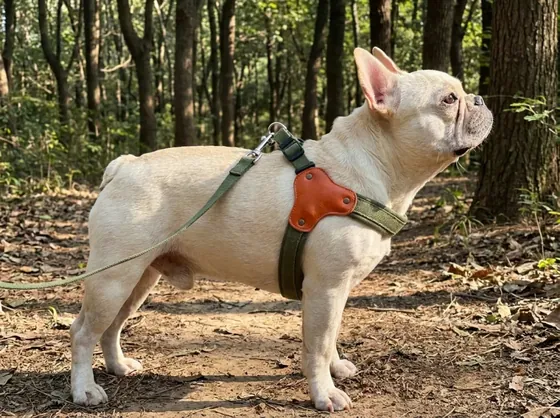
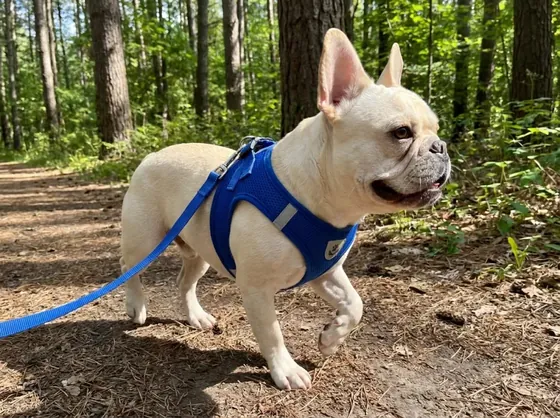
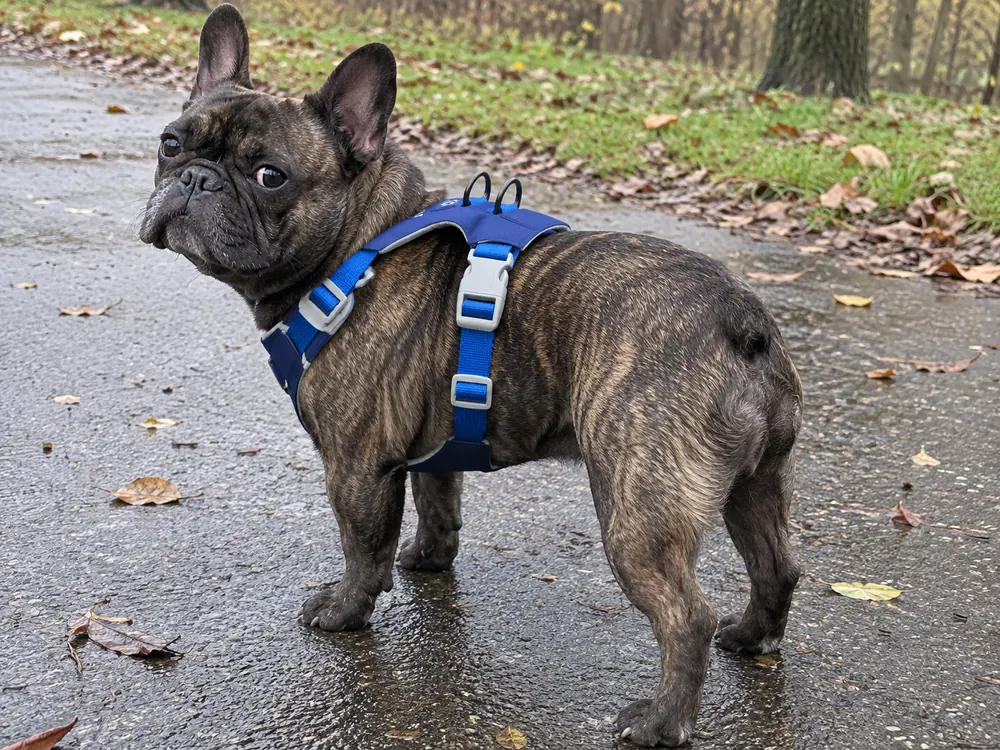
Purple has lime straps. Navy has light blue straps. Charcoal is the plain one, with a dark panel and dark straps.
The color goes on the panel and the straps, so a bright strap is what you see from across the park. Pick the one you can find in a crowd of dogs at dusk.
Measure around his chest, just behind the front legs. Use a soft tape, snug but not tight, and read the number before you look at the table.
| Size | Chest | Neck | It closes on |
|---|---|---|---|
| M | 46–61 cm / 18.1–24.0″ | 32–43 cm / 12.6–16.9″ | Most adult Frenchies |
| L | 56–80 cm / 22.0–31.5″ | 38–58 cm / 15.0–22.8″ | Broad adults |
Under 56 cm around the chest, L will hang loose, because its smallest setting is 56.
Over 61 cm, or over 43 cm around the neck, only L closes. Between 56 and 61, both close. If he lands on the line between two sizes, take the larger one.
Say the tape reads 52 cm. That is M. Say it reads 63 cm around the chest. That is L. Say it reads 58, and the neck reads 40: both close, so take L.
Chest picks the size here, not weight. A stocky dog and a lean dog of the same weight are not the same width.
“I’m getting my first bulldog a week from now and making all my purchases now.” That is a real post, and it is a good instinct with the wrong harness.
This harness does not close below 46 cm around the chest. Our puppy harness covers 32 to 49 cm. Our puppy chart puts a five-to-six-month-old at 40 to 46 cm, and you cannot measure a dog who is not home yet.
Buy the puppy harness first. Measure him once he is in the kitchen, and come back to this one when the tape says 46 or more.
“She was just stubbornly sitting and wouldn’t move.” A dog who freezes in a new harness is not being difficult. He has just met a strange thing on his chest.
Go slowly. Leave the harness on the floor for a day so he can sniff it. Hold the neck opening wide, with a treat on the far side, and let him push his head through for it.
Then buckle it, give a treat, and take it off. Do that a few times. Wear it indoors for a few minutes before the first walk. If he still will not put his head through, the step-in harness is the better choice.
After the first walk, take it off and look at his coat. See where the panel lay and where the side strap ran. Two fingers should slide under any strap when it is closed, and your whole hand should not.
By the third walk, the sliders may have crept. Check them before you leave the house, and pull the straps snug again.
By the tenth, look at the stitching around the chest loop and the D-ring. A frayed thread there is a reason to stop using it, not to tie a knot.
“Always causes chafing/redness under my pup’s armpits.” That complaint comes up again and again in Frenchie threads.
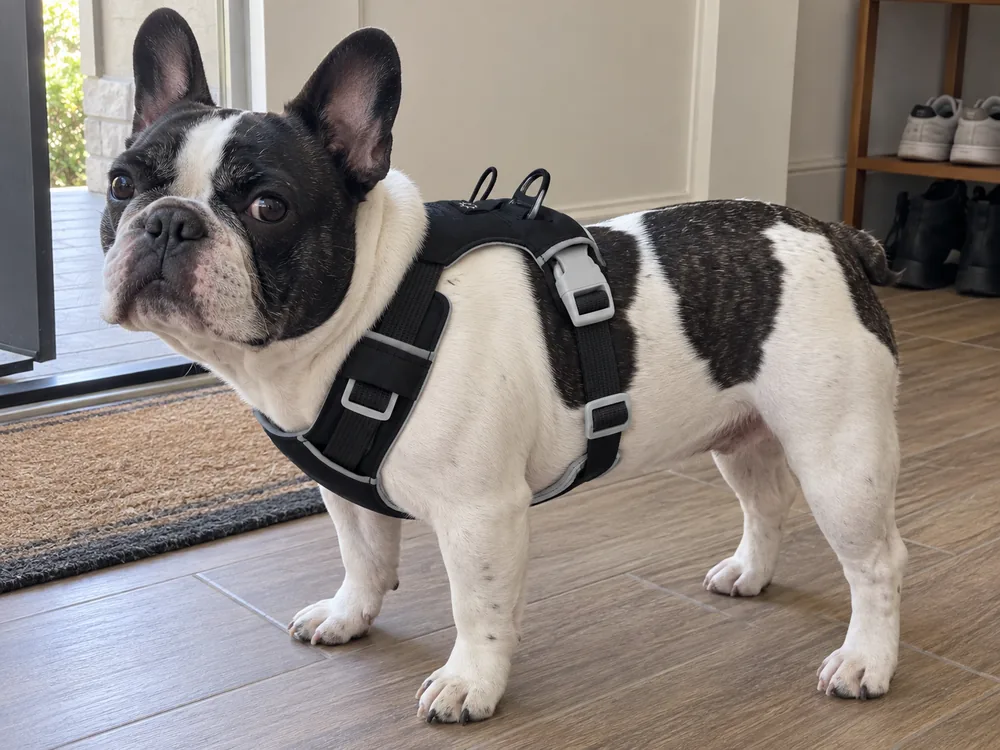
The side strap belongs behind his front legs, not tucked into the armpit. Watch it when he sits and when he lies down. A strap that rides up into the armpit is too loose or the wrong size.
If you see red skin or worn hair where a strap runs, stop using the harness that day and ask your vet. No harness is a promise that this will never happen, and we do not make one.
Machine washing and hand washing are both fine. Close the buckle and slide the straps snug first, so nothing catches in the drum.
Wash it when it is muddy, and let it dry before he wears it again.
This one is for walking. It is not for tying him up outside a shop, and it is not for tug games. A dog who bites at the straps can damage them.
If he pulls hard, take the padded front-clip harness. If he hates it going over his head, take the step-in. If he is a puppy under 46 cm around the chest, take the puppy harness.
A chest over 80 cm is outside L, and none of our sizes will close on it. If you wanted a cooling vest, this is not one.
Here are four of our harnesses, side by side.
| Harness | Goes on | Leash points | Chest panel |
|---|---|---|---|
| This quick-dry harness | Over the head, one side buckle | Strap loop on the chest, D-ring on the back | Thin cloth over mesh |
| Front-clip harness | Over the head, buckle on each side | Ring on the chest, ring on the back | Padded, cloth over foam |
| Reflective harness | Over the head, one buckle | Two D-rings, front and back | Padded chest plate |
| Step-in harness | Front legs step in, one buckle on the back | Chest and back | Mesh with an elastic chest panel |
This is the only one of the four with a pocket. If you want cushion under a hard pull, look at the two padded ones. If the head is the fight, take the step-in.
Plan on 14 days. Your harness is pulled off the shelf, checked, packed and handed to the carrier — then it travels to you. When carriers are swamped, a busy week before Christmas or a storm across half the country, it can take a few days more.
Shipping is free on every order. No minimum and no handling fee, and duty and import tax are included too — the price you see is the price you pay, with nothing to settle at the door.
A tracking number appears on our tracking page the day your parcel leaves the warehouse. Before that there is nothing to track, so we show you the stage instead.
If day 14 passes and nothing has moved, email hello@frenchieharness.com with your order number. We will chase the carrier and tell you what we find.
Measure around the chest just behind the front legs.
| Size | Chest | Neck | Fits |
|---|---|---|---|
| M | 46–61 cm / 18.1–24.0″ | 32–43 cm / 12.6–16.9″ | Most adult Frenchies |
| L | 56–80 cm / 22.0–31.5″ | 38–58 cm / 15.0–22.8″ | Broad adults |
M and L together cover a chest of 46 to 80 cm (18.1–31.5″). Under 46, take the puppy harness, which closes from 32 to 49 cm (12.6–19.3″). Over 80, this harness will not close on him.
Measure snug, straight off the tape. Do not add centimetres for slack — the chart already has it.
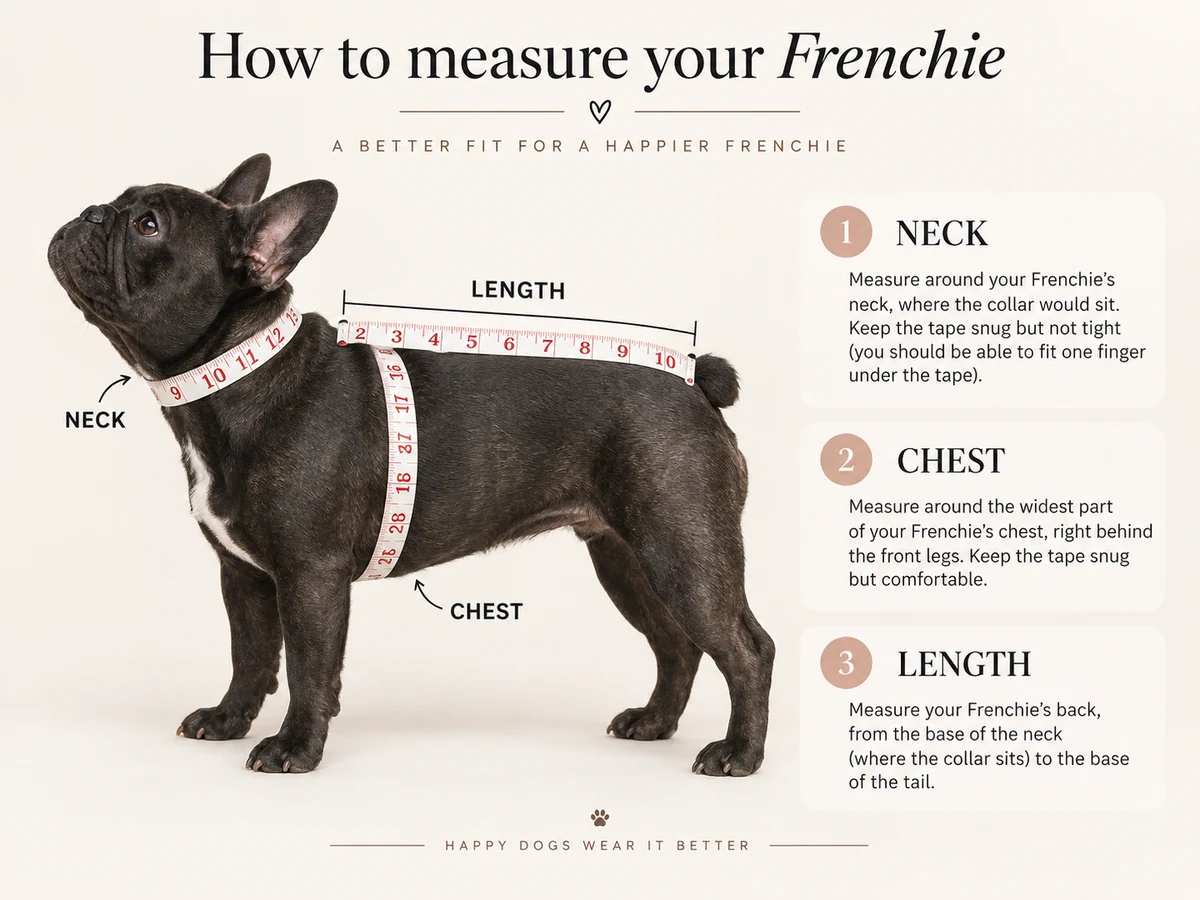
No tape at home? Use a shoelace, mark it, then hold it against a ruler. If his number falls in the gap between two sizes, take the larger one, because the smaller one stops short of him. If two sizes both cover his number, take the one where it sits farther from the edge of its range: that strap has room to tighten and to let out. If it sits exactly on the line where one size ends and the next begins, take the larger, because a harness can be taken in but not let out.
You have 30 days from delivery to send an item back. It has to be unused and in the condition it arrived in, with the tags on.
Return postage is yours. We do not send a prepaid label. If we sent the wrong item or it arrived damaged, that one is on us — postage included.
Email hello@frenchieharness.com with your order number to start one. You get the return address by reply, usually the same working day. Do not send anything back before you have it.
Once your parcel reaches us we approve the refund within a working day or two; your bank then posts it back within 5–7 working days.
Reviews are for verified buyers only. Enter your order number so we can confirm your purchase.
Your review was received — we really appreciate you taking the time.
Pick his size and it goes straight in the cart.
 Frenchie Harness