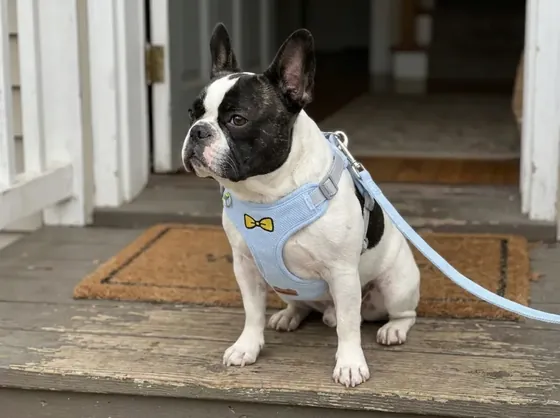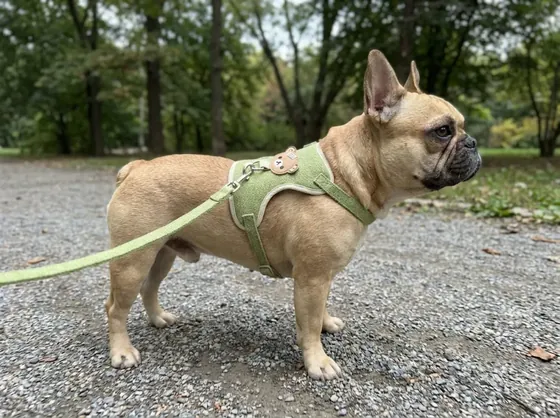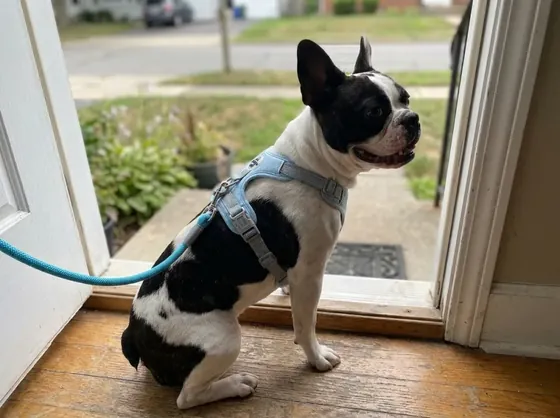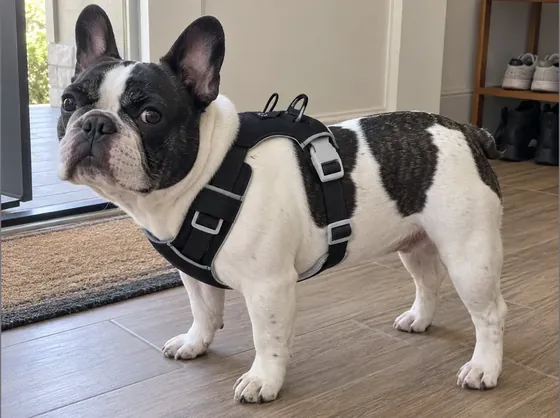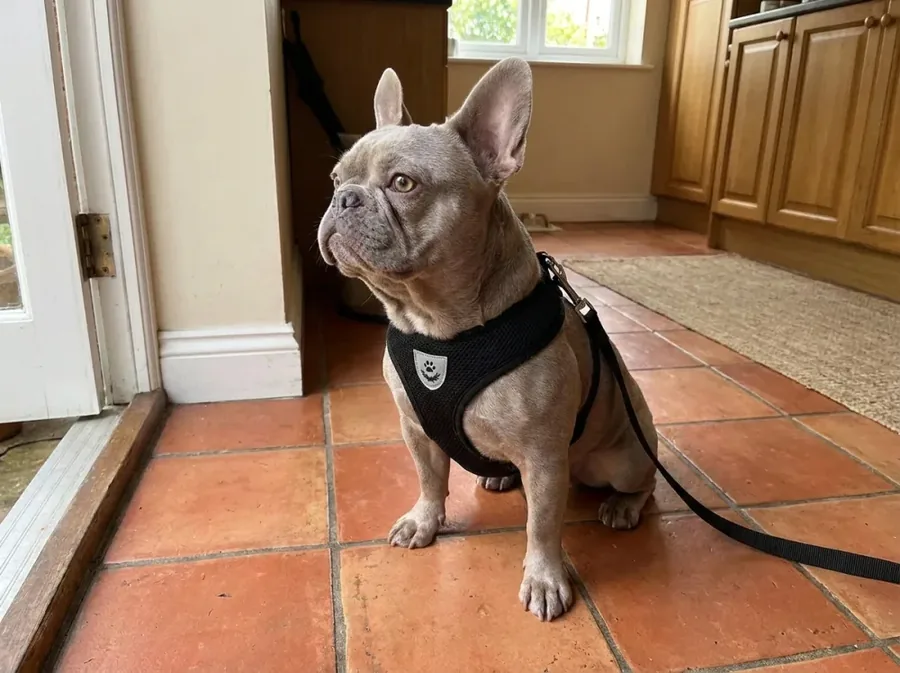
“Sizing recommendations for a typical 25 lb Frenchie?” An owner asked that on r/Frenchbulldogs, and it is the first question this page has to answer.
For this vest the answer is short: not this one. A 25 lb Frenchie weighs 11.3 kg. The XL is meant for dogs of 6 to 7.5 kg, which is 13.2 to 16.5 lb. Pick another harness from the shop for him.
This is a vest for a smaller dog. It suits a puppy who is still under 7.5 kg, and a Frenchie who stays small. You get a light mesh vest in two sizes and a 1.2 m leash in the box.
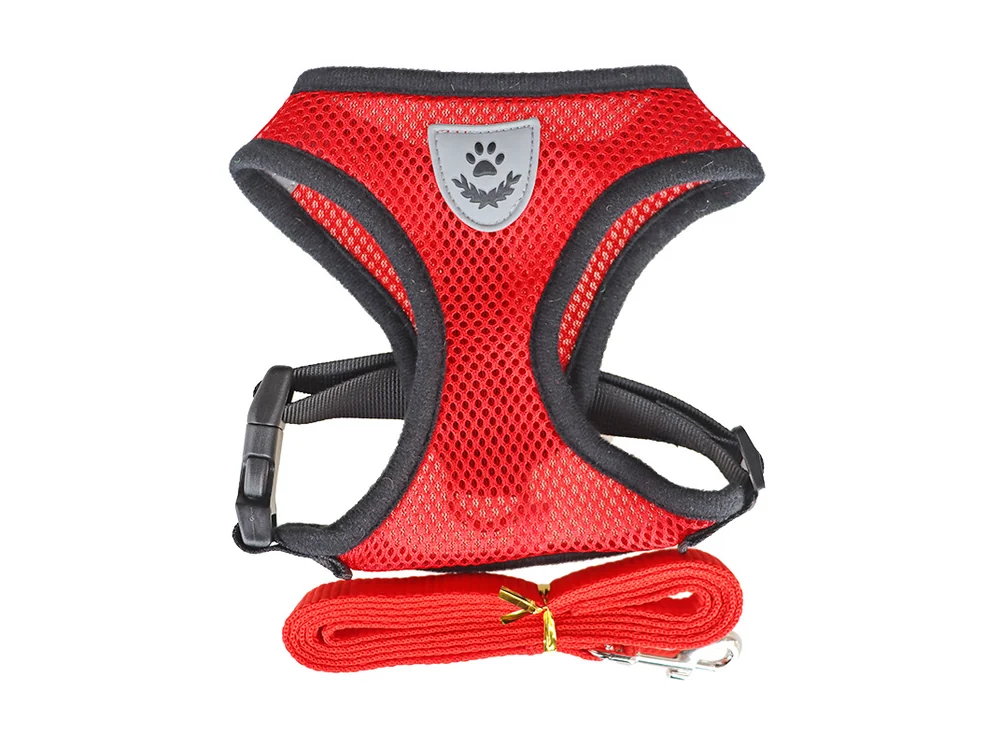
Three facts before you read on. The vest weighs 80 or 85 g. It reflects light in three spots. It goes on over his head and closes with one buckle at his side.
The fabric is polyester sandwich mesh. That means two faces of open mesh held apart by thin threads, so there is a gap of air between them.
Weight is 80 g in the L and 85 g in the XL, which is 2.8 and 3.0 oz. The edge around the neck and both leg openings is soft black binding. The straps are flat black webbing.
The hardware is short. One black plastic buckle closes the chest strap on one side of his body, and a slider on the other side sets the length. One metal D-ring hangs from a webbing strap sewn down the middle of the back panel. That ring is the only place to clip the leash.
The leash is in the box with every color. It is flat webbing, 1.2 m (3.9 ft) long and 1.5 cm (0.6 in) wide, in the color of the vest. The metal clip is made to swivel, so the leash does not wind around itself. It is a plain walking leash.
It is 5 p.m. in November and the light is gone. A car backs out of a driveway, and its headlights sweep across a low dog on the pavement.
The paw shield on his chest is reflective. So is a strip on each shoulder, on the back panel. From the front the driver sees the shield. From the side or from behind the driver sees the strips.
Reflective film sends light back toward where it came from. It helps a driver notice him sooner. It does not make a dark road safe. On a road without a sidewalk, keep him on a short length of leash, close to you.
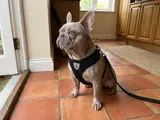
Six colors are in the shop: black, blue, red, green, orange and coffee brown. Every one carries a paw shield. On black and on coffee, the pale shield is the one light patch on the front of him.
Put a soft tape around him behind his front legs, at the widest part of his chest, and keep it flat and snug. Read the number off the tape and take it to the table as it is. Nothing gets added.
The neck needs a second look. One owner wrote that Frenchies have “thick, muscular necks that are almost the same width as their heads.” On a vest that goes over the head, that matters twice.
The opening must clear the head, and it cannot be tightened. It is fixed at 34 cm on the L and 38 cm on the XL.
So tape the widest part of his head as well. If that number is bigger than the neck opening, the vest will not go on without a fight.
| Size | Chest | Neck opening | Dog weight | Vest weight |
|---|---|---|---|---|
| L | about 46 cm / 18.1″ | 34 cm / 13.4″ | 4–6 kg / 8.8–13.2 lb | 80 g / 2.8 oz |
| XL | about 57 cm / 22.4″ | 38 cm / 15.0″ | 6–7.5 kg / 13.2–16.5 lb | 85 g / 3.0 oz |
This chart gives one number per size, not a range, so find the number closest to his tape. A 48 cm chest is an L, and a 55 cm chest is an XL.
Exactly halfway, at 51.5 cm, take the XL, because its strap can be pulled in and an L that is too small cannot be let out. Under 46 cm or over 57 cm, this vest is not for him.
Then check the weight column. The two columns do not always agree: a 57 cm chest on a dog of 7.5 kg is a stocky dog. If the tape says XL and the scale says 9 kg, believe the scale and choose another harness.
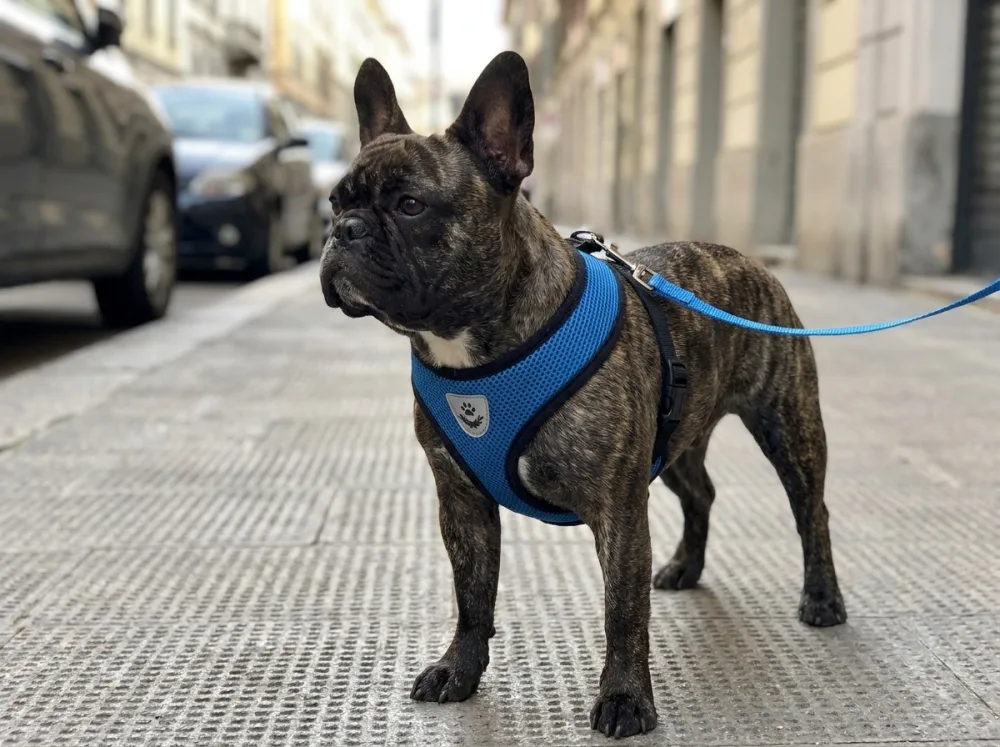
There is no buckle at the neck or on the shoulders. The neck opening is a closed loop of mesh with soft binding, so his head goes through it first. Here is the order.
First, open the buckle and slide the strap loose. Next, lift the neck opening over his head and let the panel rest on his chest. Then bring the strap under his ribs, behind the front legs. Last, click the buckle and pull the slider until two flat fingers fit under the strap.
One owner wrote that a harness “always causes chafing/redness under my pup’s armpits.” Where the strap sits decides that. It belongs across the ribs. It does not belong in the hollow right behind the front leg.
A dog who hates a loop near his ears will hate this vest. One owner picked a harness because it “doesn’t go over the head (which my guy hates).” If that is your dog, look at the Step-In Harness. His front legs step into two openings and nothing passes over his face.
“The harness tends to pull and twist to the side a lot.” That is how one owner described a harness on a dog who pulls. Here is what that means on this vest.
The only leash ring is the D-ring on his back. When he lunges, the leash pulls that ring backward, and the chest panel pulls against his chest. Nothing turns him toward you. He can lean into it and keep going.
When the vest rides sideways, check the chest strap first. Often the strap is loose. Two flat fingers, no more, and the ring stays in the middle of his back.
A vest with one back ring is not a no-pull harness. For a Frenchie who leans into the leash the whole walk, the Front-Clip No-Pull Harness has a ring on the chest panel as well as one on the back. Its sizes go by weight, from 4 to 17.5 kg.
Some of you are choosing between this vest and its two closest cousins here. These are the numbers from each product page.
| This vest | Plain Mesh Step-In | Mesh Harness | |
|---|---|---|---|
| Widest chest | about 57 cm / 22.4″ | 61 cm / 24.0″ | 55 cm / 21.7″ |
| Sizes in the shop | 2 (L, XL) | 3 (M, L, XL) | 4 (S, M, L, XL) |
| Colors | 6 | 5 | 4 |
| Buckle | 1, on one side of the chest strap | 1, under the belly | 1, on his back |
| Leash ring | 1 D-ring on his back | 1 D-ring on his back | 1 ring on his back |
None of these is better than the others. They differ in how wide they close and where the buckle sits, so pick by the tape.
If grams are what you care about, the Knitted Vest Harness is cloth instead of mesh. It weighs 60 g in the M and 68 g in the L, with a chest of 34 to 54 cm.
“She was just stubbornly sitting and wouldn’t move.” An owner wrote that about a 4-month-old puppy on her first walks in a harness. If yours does that, the fix is not a longer walk. It is the living room.
On day one, put the vest on, hand him a treat, and take it off after 10 minutes. On day two, keep it on for 20. On day three, clip the leash on and walk one lap of the hallway. Only then go outside.
On the third walk, stop after ten minutes and run two flat fingers under the strap again. A strap that fit in the hallway can sit differently on the pavement. On the tenth walk, look at the ring. It should still sit in the middle of his back, and the buckle should click shut without a fight.
After each walk, take the vest off and part the fur where the strap and the leg openings sat. Flattened fur, a shiny patch or pink skin shows where it rubbed. Loosen the strap or move it, and look again after the next walk.
If the skin is still red the next day, or he keeps licking one spot, call your vet. That is a job for a vet, not for a different vest.
A dog over 7.5 kg (16.5 lb) is above what the XL is meant for. Look at the Front-Clip No-Pull Harness, which is sized by weight up to 17.5 kg, or the Step-In Harness, which closes to a chest of 58 cm.
A puppy of eight weeks is too small for the L. Its neck opening is 34 cm. The Puppy Harness XS is cut for a neck of 27 to 31 cm and a chest of 32 to 37 cm.
A dog who pulls hard needs a ring on the chest. That is the Front-Clip No-Pull Harness again. A dog who hates things over his head needs the Step-In Harness.
If none of those is your dog, this is a plain, light vest. It holds a small dog on a 1.2 m leash and shows up in headlights at 5 p.m. That is all it does.
Plan on 14 days. Your harness is pulled off the shelf, checked, packed and handed to the carrier — then it travels to you. When carriers are swamped, a busy week before Christmas or a storm across half the country, it can take a few days more.
Shipping is free on every order. No minimum and no handling fee, and duty and import tax are included too — the price you see is the price you pay, with nothing to settle at the door.
A tracking number appears on our tracking page the day your parcel leaves the warehouse. Before that there is nothing to track, so we show you the stage instead.
If day 14 passes and nothing has moved, email hello@frenchieharness.com with your order number. We will chase the carrier and tell you what we find.
Tape his chest just behind the front legs and read the number as it is. From 46 to 51.4 cm (18.1 to 20.2″) take the L. From 51.5 to 57 cm (20.3 to 22.4″) take the XL.
| Size | Chest | Neck | Weight |
|---|---|---|---|
| L | about 46 cm / 18.1″ | 34 cm / 13.4″ | 80 g |
| XL | about 57 cm / 22.4″ | 38 cm / 15.0″ | 85 g |
A chest under 46 cm (18.1″) or over 57 cm (22.4″) is outside both sizes. So is a dog over 7.5 kg (16.5 lb), the most the XL is meant for.
Measure snug, straight off the tape. Do not add centimetres for slack — the chart already has it.
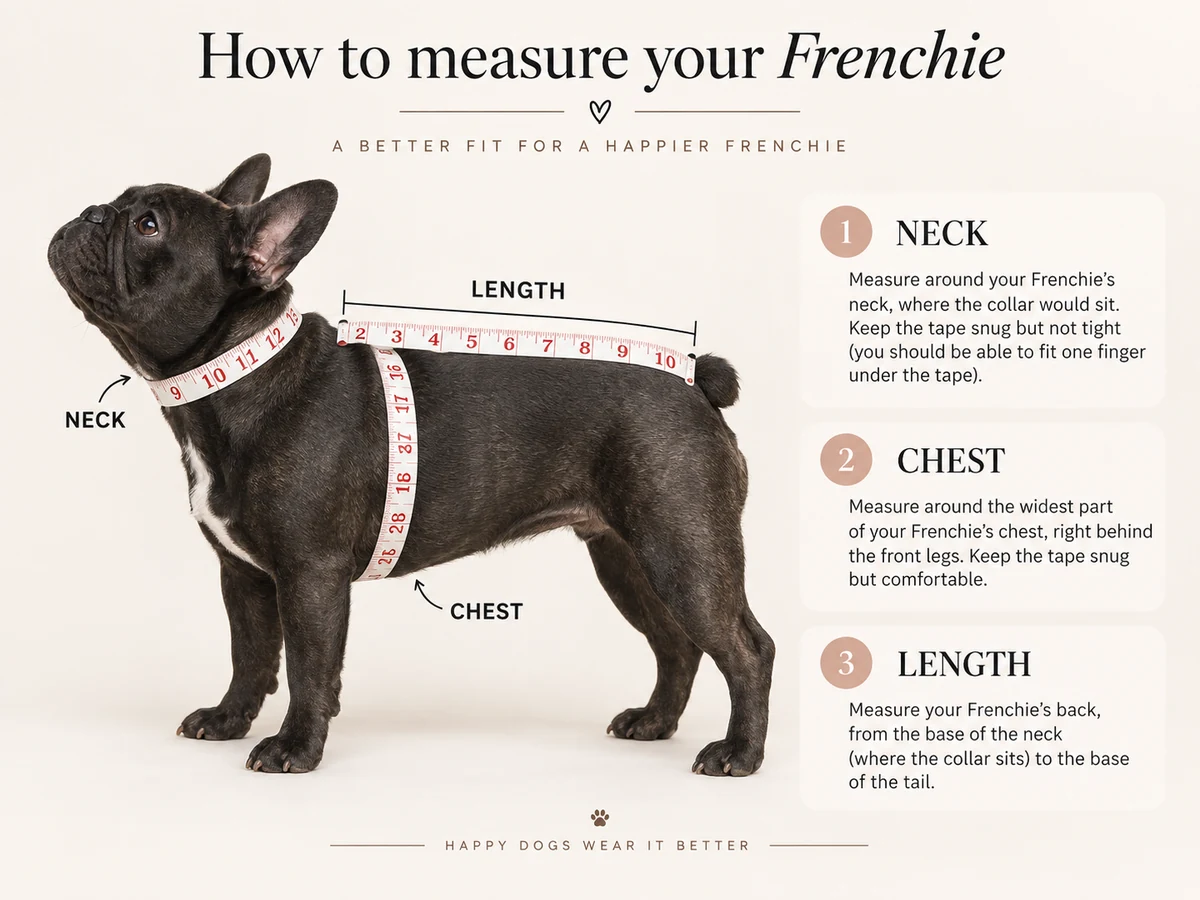
No tape at home? Use a shoelace, mark it, then hold it against a ruler. Each size here is cut for one number, not a range, so take the size whose number is closest to his. If he sits exactly halfway between two, take the larger, because a harness can be taken in but not let out.
You have 30 days from delivery to send an item back. It has to be unused and in the condition it arrived in, with the tags on.
Return postage is yours. We do not send a prepaid label. If we sent the wrong item or it arrived damaged, that one is on us — postage included.
Email hello@frenchieharness.com with your order number to start one. You get the return address by reply, usually the same working day. Do not send anything back before you have it.
Once your parcel reaches us we approve the refund within a working day or two; your bank then posts it back within 5–7 working days.
Reviews are for verified buyers only. Enter your order number so we can confirm your purchase.
Your review was received — we really appreciate you taking the time.
 Frenchie Harness