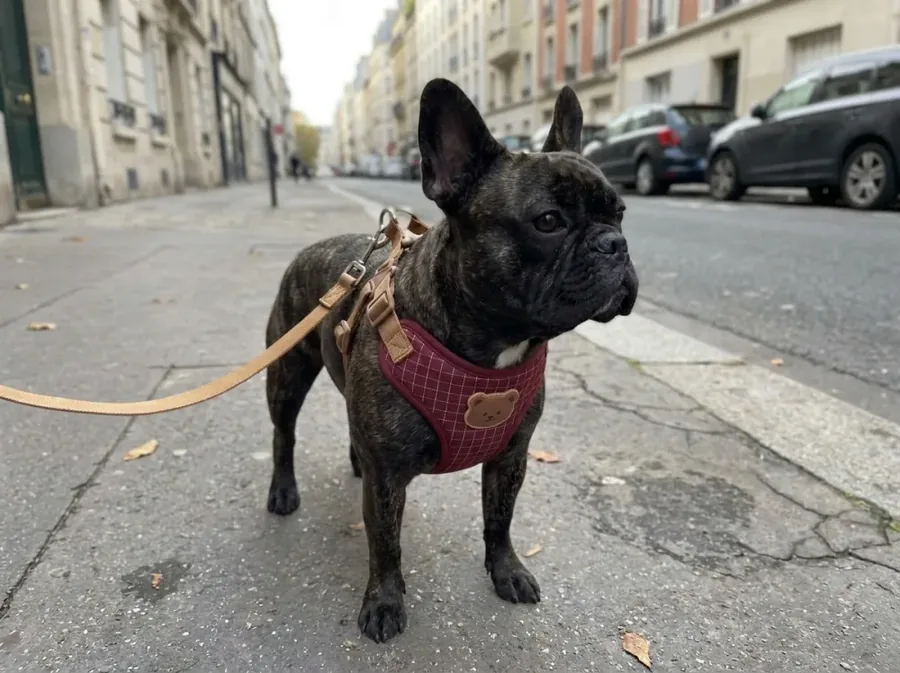
“Best fit and doesn’t go over the head (which my guy hates).” An owner wrote that about his Frenchie’s harness. It is the whole case for a step-in.
This one lies open on the floor. Your Frenchie puts one front paw through each of the two openings, and you lift the straps over his back and click one buckle shut on top of it.
Nothing passes over his ears, his eyes or his flat nose. If he stiffens when a loop comes near his face, this is the design to try first.
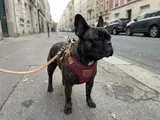
A Frenchie is broad in the chest and thick in the neck, and this harness has no loop at the neck at all. Tan straps run over his shoulders to two black metal rings on his back, and a woven check panel covers the front.
A bear-head patch sits low on that panel, and a matching leash comes in the box. Here is the routine: lay it flat, let him step in one paw at a time, lift the straps and click. A treat held at nose height keeps his head busy while his paws go in.
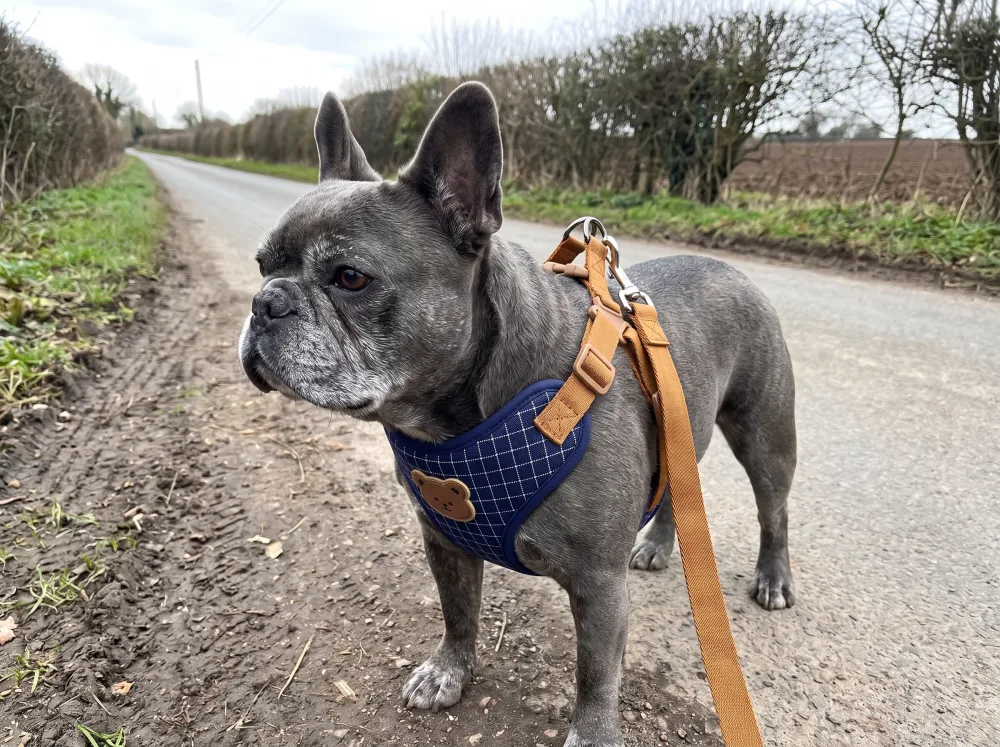
“Sizing recommendations for a typical 25 lb frenchie?” Someone typed that into a forum. It is the right question, and pounds cannot answer it here.
Two Frenchies of the same weight can be built differently around the ribs, so this set is sized by tape. The Chest column in the size guide lists the chest each size is cut to hold. It is his chest you look up, not the harness lying flat on a table.
Use a soft tape, the kind from a sewing box. Wrap it around his chest right behind the front legs, where the ribs are widest. Keep it flat and snug, with no slack and no squeeze. Write the number down and look it up as it is. Nothing gets added.
Two fingers come later, once the set is buckled on him: two flat fingers should slide under a strap.
Here are seven worked examples. Find your number in the first column.
| Tape reading | Chest range that holds it | Order |
|---|---|---|
| 32 cm (12.6 in) | XS, 32–36 cm | XS |
| 35 cm (13.8 in) | XS, 32–36 cm | XS |
| 38 cm (15.0 in) | S, 36–42 cm | S |
| 43 cm (16.9 in) | M, 40–46 cm | M |
| 48 cm (18.9 in) | L, 44–52 cm | L |
| 56 cm (22.0 in) | XL, 50–62 cm | XL |
| 63 cm (24.8 in) | None, above 62 cm | Not this set |
Some ranges overlap. The M runs 40 to 46 cm and the L runs 44 to 52 cm, so a tape of 44 cm is held by both. Take the size where your number sits farther from the edge of its range. At 44 cm the M has 2 cm to spare and the L has none, so it is an M.
At 45 cm they tie, 1 cm from the edge of each. A tie goes to the larger, so that is an L. The sliders can take up extra strap, but nothing can add strap that is not there.
If a number fell in a gap between two rows, the larger would be the right size. This table has no gap between 32 and 62 cm, so only the overlap rule comes up.
“I’m getting my first bulldog a week from now and making all my purchases now.” If that is you, there is no chest to measure yet.
Ask the breeder to tape the pup behind the front legs, or wait and tape him on the first evening. Do not order by age, because puppies of the same age can differ a lot around the chest.
The Neck column in the size guide works the same way. Tape him where a collar would sit and check that number too. If the neck and the chest point to different sizes, take the larger.
The XS starts at a chest of 32 cm and the XL closes at 62 cm. A dog outside that range needs a different harness.
“The harness tends to pull and twist to the side a lot.” That is an owner describing a dog who leans into the leash. If that is yours, read this part before you order.
Two black metal rings sit side by side on top of his back, between the shoulder blades. The leash clips to them. There is no ring on the chest.
Here is what that means on a walk. The leash pulls from above his shoulders, straight back to your hand. When he leans, he leans against a line that runs behind him, and nothing on this harness swings him around.
A ring at the breastbone works differently, because a hard pull swings his front end toward you. Our front-clip harness has that ring. Even that one only turns him. It does not teach him to stop.
If your Frenchie walks beside you and only surges now and then, two back rings are fine. If he hauls you to every corner, this is not the set. The table puts three harnesses side by side.
| This set | Front-clip harness | Y-shaped step-in | |
|---|---|---|---|
| Goes on | Step in, one buckle on the back | Over the head, a buckle on each side | Step in, one buckle on the back |
| Leash rings | 2, both on the back | 1 on the chest, 1 on the back | 2, both on the back |
| Leash in the box | 150 cm (59 in), tan | 1.5 m (4.9 ft), matching color | 2 m (6.6 ft) rope, black |
| Sized by | Chest, 32–62 cm (12.6–24.4 in) | Weight, 4–17.5 kg (8.8–38.6 lb) | Chest, 34–66 cm (13.4–26.0 in) |
| Sizes | XS, S, M, L, XL | S, M | S, M, L |
The ring row decides what a hard pull does. The Y-shaped step-in goes on the same way as this set and closes at a chest of 66 cm, 4 cm wider than the XL here. If your tape says 64 cm, look at that one.
A harness that twists to one side usually has one strap longer than its twin. The panel drifts toward the short side, and every pull makes it worse. Fixing it takes a minute.
This set has four sliders, two on each side. Set them on day one, with him standing still on a floor that is not slippery, and make the left side match the right. The bear-head patch is your marker: it should sit in the middle of his breastbone, not drift toward one leg.
After that, the daily work is one plastic buckle on top of his back, under the rings. Click it shut, then tug the two straps apart to be sure it holds.
Now the two-finger check. Slide two flat fingers under a strap, against his chest. They should go in without a fight and come out with a small tug. If fur bunches up under the strap, it is too tight, so let the slider out a little.
More room than two fingers is how a dog backs out. Slack behind the front legs is the usual way out of a step-in, so slide two fingers under those straps again five minutes into the first walk.
No harness should be trusted to hold a dog beside traffic. The leash in your hand is the other half of keeping him close.
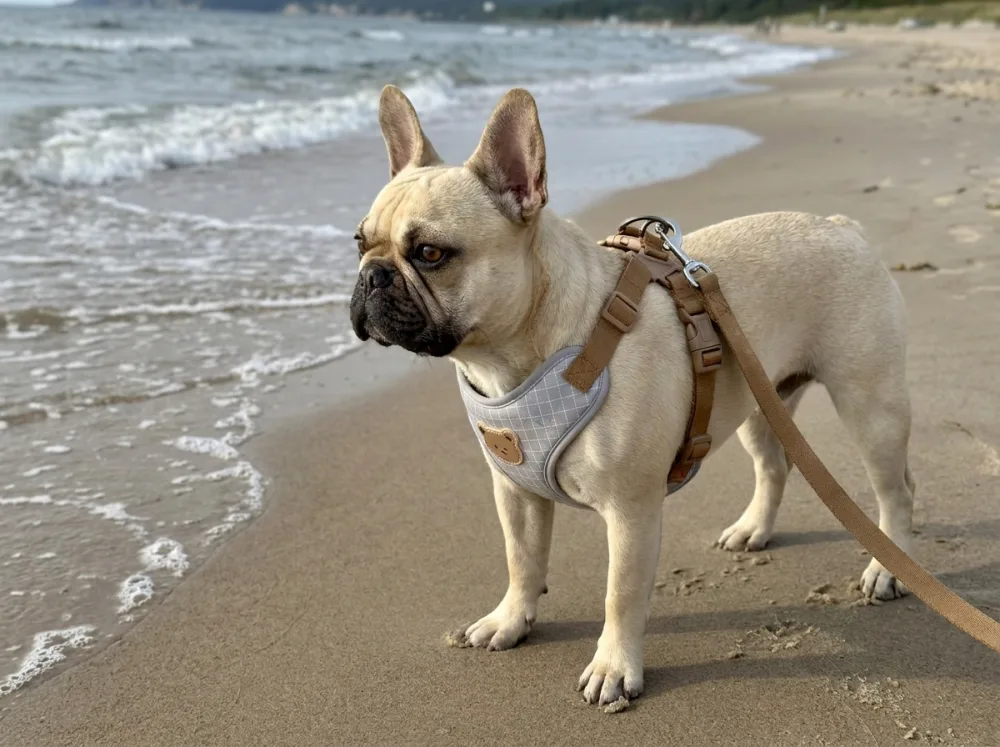
“I tried her on a harness for walks the first few times but she was just stubbornly sitting and wouldn’t move.” Some dogs freeze when something new is on their body. It is not a contest to win.
So skip the walk on day one. Stay in the kitchen with no leash. Hold a treat by his nose, let him step in, click the buckle, give the treat and take the set off. Do that three times and stop while he still wants more.
On day two, put it on for ten minutes at home and clip the leash to a ring. Hold the strap slack. On day three, go out the front door and around the block.
If he sits down on the sidewalk, stop and stand still and let him decide to get up. Then walk a few steps more and go home while it is still a good walk.
“I’ve read all about how they’re supposed to fit, and make sure the straps aren’t directly in her armpits and instead go around the widest part.” That owner has the rule right. The straps should lie across the ribs, behind the elbow.
Here is how to check. Lift his front leg forward. The strap and the edge of the chest panel should not bunch in the crease behind the elbow. If they do, move the slider on that side until the strap lies across the ribs.
After the first walk, part the fur behind his front legs. Is it flat, damp or bunched, and is the patch still in the middle of his chest? If it slid to one side, reset the sliders.
After the third walk, look at the buckle and the sliders. Has a slider crept and let a strap out? Click the buckle shut and tug it once.
After the tenth walk, look at the skin where a strap runs and compare it with his belly. If you see redness, a bare patch or a sore, stop using the harness and show your vet. Do not decide what it is yourself.
Numbers first, so you can picture the box. This is everything on the harness and the leash.
| Part | What it is | How many |
|---|---|---|
| Chest panel | Woven check fabric, brown lining, soft edge around both leg openings | 1 |
| Bear-head patch | Brown, low on the front of the panel | 1 |
| Rings | Black metal, side by side on top of the back | 2 |
| Buckle | Plastic, on top of the back, under the rings | 1 |
| Sliders | Plastic, two on each side | 4 |
| Leash | Flat tan strap, 150 cm (59 in), metal snap hook | 1 |
The five colors are red, gray, off-white, blue and green. The panel is a burgundy, a gray, a cream, a navy or an olive, with a fine light grid. Straps and leash are the same tan in all five.
Pick the size first and the color last. The color does not change what fits him. The leash is 150 cm (59 in) in every size, and the XS weighs 106 g (3.7 oz) against 136 g (4.8 oz) for the XL.
Better to hear it now than to send a box back.
A chest that tapes above 62 cm. The XL closes at 62, and the Y-shaped step-in reaches 66.
A chest that tapes under 32 cm. The XS starts at 32.
A dog who hauls. Both rings sit on his back, so a hard pull is met head on. A ring on the chest is what turns a hauler.
An owner who wants a handle. There is none on the harness.
A dog who will not lift a paw. Stepping in needs two paws through two openings. If he fights that every time, no step-in will suit him.
A car ride. This is a walking harness, and we make no claim that it works as a car restraint.
Everyone else: tape him flat and snug, look the number up in the table, and check two fingers under a strap once the set is on. A Frenchie who dislikes things over his head is the dog it suits best.
Plan on 14 days. Your harness is pulled off the shelf, checked, packed and handed to the carrier — then it travels to you. When carriers are swamped, a busy week before Christmas or a storm across half the country, it can take a few days more.
Shipping is free on every order. No minimum and no handling fee, and duty and import tax are included too — the price you see is the price you pay, with nothing to settle at the door.
A tracking number appears on our tracking page the day your parcel leaves the warehouse. Before that there is nothing to track, so we show you the stage instead.
If day 14 passes and nothing has moved, email hello@frenchieharness.com with your order number. We will chase the carrier and tell you what we find.
Two measurements decide the size. Neck: right where a collar would sit, at the base of the neck. Chest: around the widest part, just behind the front legs. Measure with a soft tape, snug but not pulled tight.
| Size | Neck | Chest |
|---|---|---|
| XS | 28–34 cm / 11.0–13.4″ | 32–36 cm / 12.6–14.2″ |
| S | 32–38 cm / 12.6–15.0″ | 36–42 cm / 14.2–16.5″ |
| M | 36–42 cm / 14.2–16.5″ | 40–46 cm / 15.7–18.1″ |
| L | 40–46 cm / 15.7–18.1″ | 44–52 cm / 17.3–20.5″ |
| XL | 44–50 cm / 17.3–19.7″ | 50–62 cm / 19.7–24.4″ |
Every size comes with the same 150 cm (about 59 in) matching leash. Where two rows hold his number, take the one where it sits farther from the edge of its row, and the larger on an exact tie. In a gap between rows, take the larger. There is no gap between 32 and 62 cm here. Once the set is on him, two fingers should slide flat under a strap.
Measure snug, straight off the tape. Do not add centimetres for slack — the chart already has it.
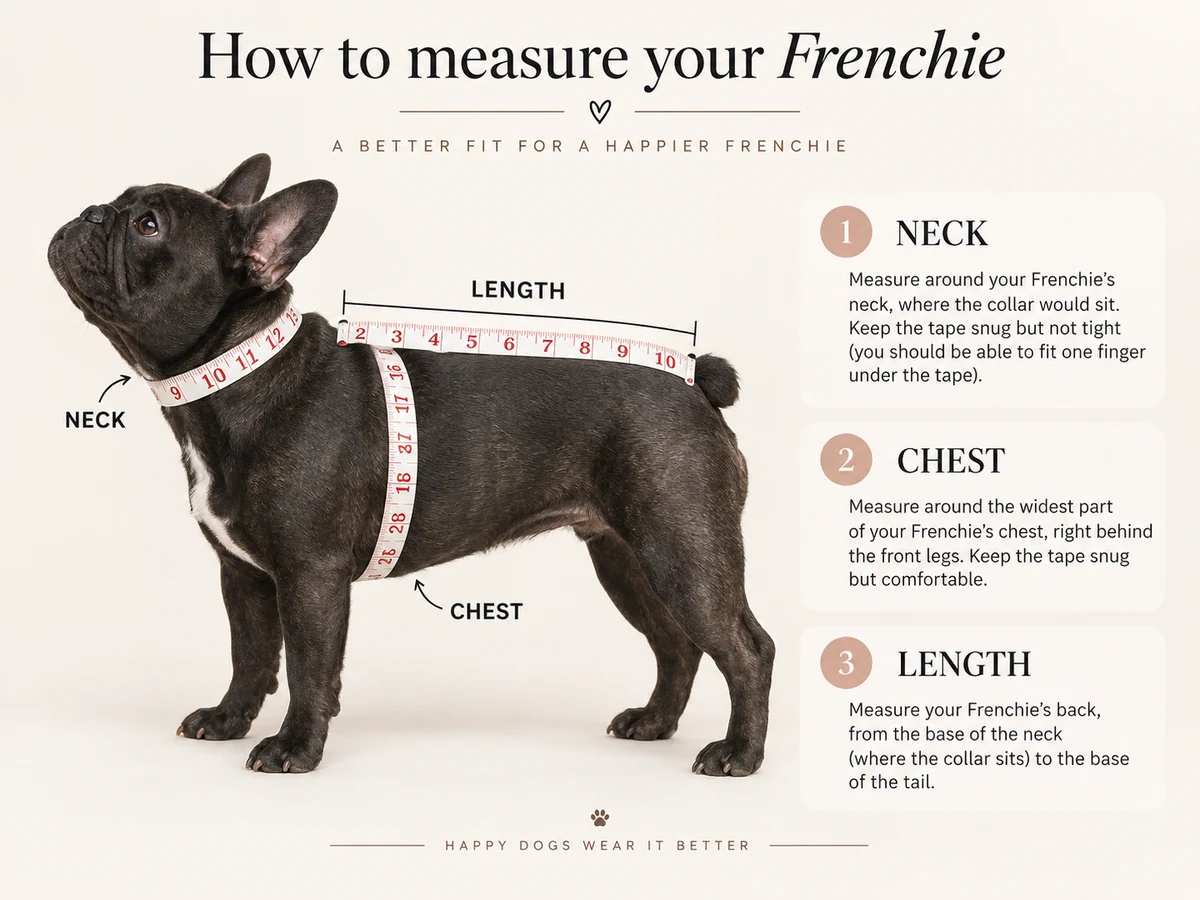
No tape at home? Use a shoelace, mark it, then hold it against a ruler. If his number falls in the gap between two sizes, take the larger one, because the smaller one stops short of him. If two sizes both cover his number, take the one where it sits farther from the edge of its range: that strap has room to tighten and to let out. If it sits exactly on the line where one size ends and the next begins, take the larger, because a harness can be taken in but not let out.
You have 30 days from delivery to send an item back. It has to be unused and in the condition it arrived in, with the tags on.
Return postage is yours. We do not send a prepaid label. If we sent the wrong item or it arrived damaged, that one is on us — postage included.
Email hello@frenchieharness.com with your order number to start one. You get the return address by reply, usually the same working day. Do not send anything back before you have it.
Once your parcel reaches us we approve the refund within a working day or two; your bank then posts it back within 5–7 working days.
Reviews are for verified buyers only. Enter your order number so we can confirm your purchase.
Your review was received — we really appreciate you taking the time.
Pick his size and it goes straight in the cart.
 Frenchie Harness