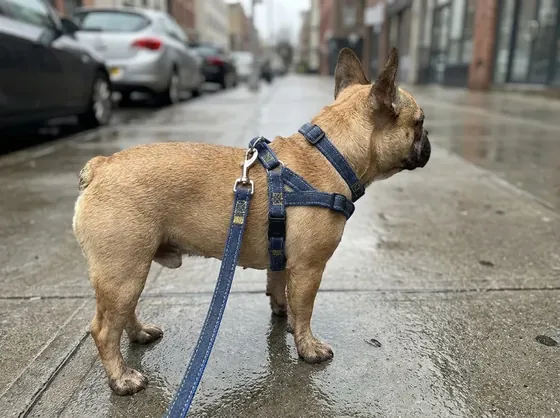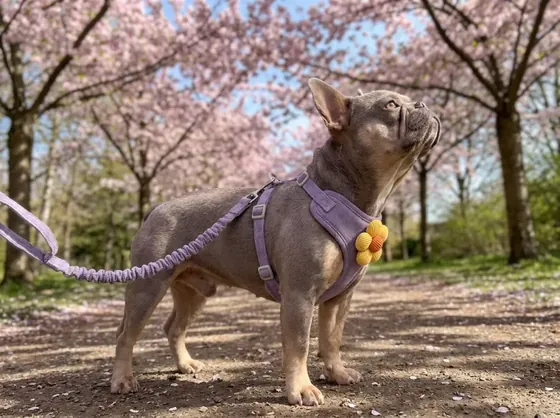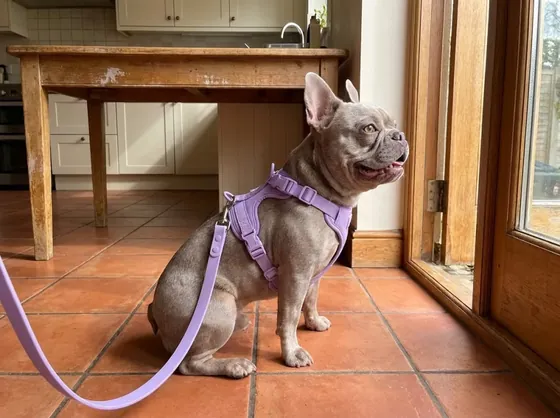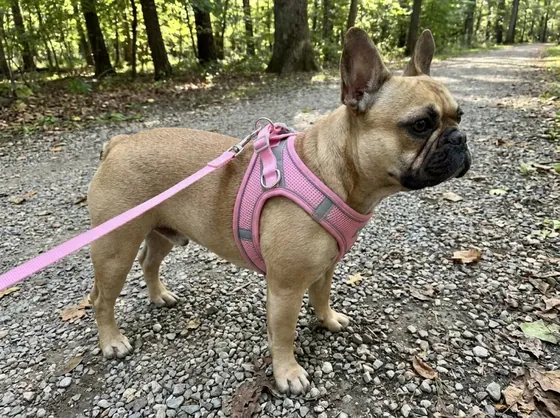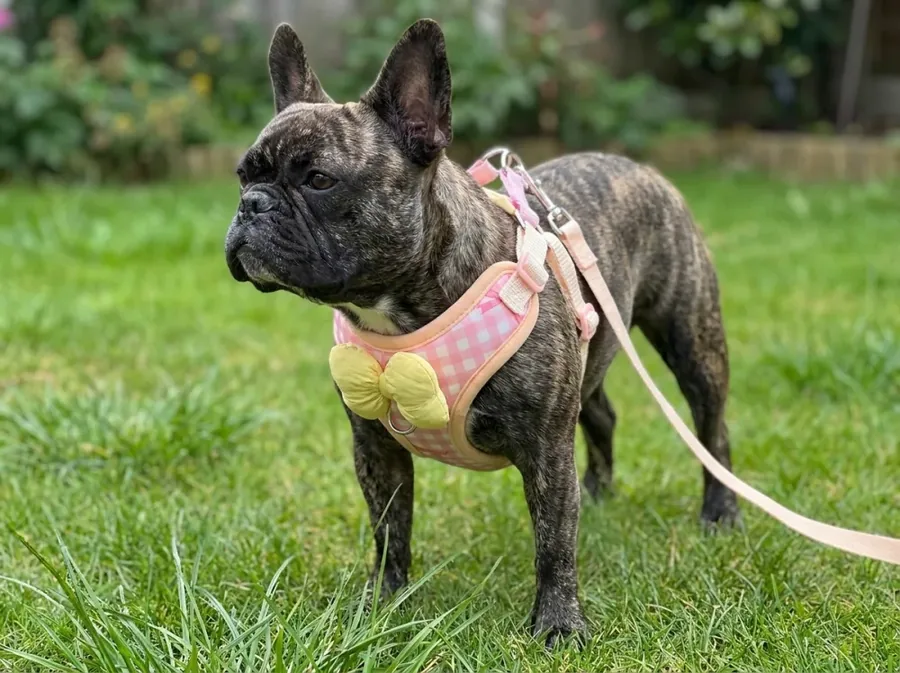
“Sizing recommendations for a typical 25 lb frenchie?” Someone typed that into a forum. It is the right question to ask before you order anything with a bow on it.
For this set, the answer is the XL. It adjusts to a chest of 54 to 62 cm (21.3 to 24.4 in) and is cut for dogs of 10 to 14 kg (22 to 31 lb). A 25 lb Frenchie weighs 11.3 kg, so he sits inside that range.
This is a plaid harness in a gingham check, with a matching leash in the same box. There are three sizes, M, L and XL, and five colors. The rest of this page helps you pick the right size on the first order.
The Chest column is how far the harness adjusts around the ribs. It is not the size of your dog. The Weight column is the dog each size is cut for. Both come in metric and in pounds, so you do not need a calculator.
| Size | Neck | Chest | Weight |
|---|---|---|---|
| M | 32–40 cm / 12.6–15.7 in | 43–51 cm / 16.9–20.1 in | 3.5–6.5 kg / 7.7–14.3 lb |
| L | 40–45 cm / 15.7–17.7 in | 50–56 cm / 19.7–22.0 in | 7–10 kg / 15.4–22.0 lb |
| XL | 45–54 cm / 17.7–21.3 in | 54–62 cm / 21.3–24.4 in | 10–14 kg / 22.0–30.9 lb |
Use the tape first and the scale second. If they disagree, the tape wins. Two Frenchies of the same weight can carry it very differently around the ribs.
Some numbers overlap. The M and the L share 50 to 51 cm, and the L and the XL share 54 to 56 cm. If he lands there, take the row that holds his number farther from its edge. On the exact middle of a shared stretch, at 50.5 or 55 cm, take the larger. The sliders take up the extra.
A gap between two sizes is a different case, and there the larger size is the right one. This chart has no gap: every number from 43 to 62 cm sits in at least one row.
The smallest size we carry is the M. A puppy under 3.5 kg, or with a chest under 43 cm, is smaller than it. The biggest is the XL, and it closes at 62 cm at the widest.
Use a soft tape, the kind from a sewing box. Put it around his chest right behind the front legs, where the ribs are widest. Keep it flat and snug, not tight. Write the number down.
Now find that number in the Chest column, just as the tape gave it. The table is written for the dog, so nothing gets added. Say the tape reads 52 cm. Only the L holds that number, so it is the L.
Some numbers sit in two rows. Say it reads 50 cm. Both the M and the L hold it, but 50 sits on the very edge of the L’s range and 1 cm inside the M’s, so the M is the one to take. At 54 cm the same test gives the L, and at 56 cm it gives the XL.
Right in the middle of a shared stretch, at 50.5 or 55 cm, both rows are equally far from their edges. There the larger one wins, because a harness can be taken in but not let out.
Two fingers come later, once the harness is on him and the buckle is shut.
A wiggly dog is easier to measure with two people. One holds a treat at his nose and the other holds the tape. Measure twice. If the two numbers differ, use the bigger one.
“I'm getting my first bulldog a week from now and making all my purchases now.” An owner wrote that. With a puppy who is not home yet, there is no chest to measure.
Then order by weight. A puppy who is 4 kg on arrival day is an M. Measure him that first evening and check the number against the table. He will outgrow the M, so plan on a second size.
Walk around him and read the harness from front to back.
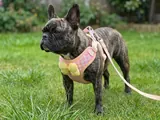
On his chest sits one panel of printed gingham. The fabric is a twill weave, the kind with a fine diagonal rib you can see up close. On the side that touches him, the panel is lined with mesh, a honeycomb of small holes.
The edge of the panel is a soft rolled trim in a second color. That edge runs around the two openings for his front legs, so it is the part to check on every walk.
A puffed bow sits on the panel. Under the bow hangs a small metal ring. A name tag can hang from it. The leash does not go there.
Each corner of the panel has a slider where a strap meets it. There is no handle on his back and no ring on the front of the chest.
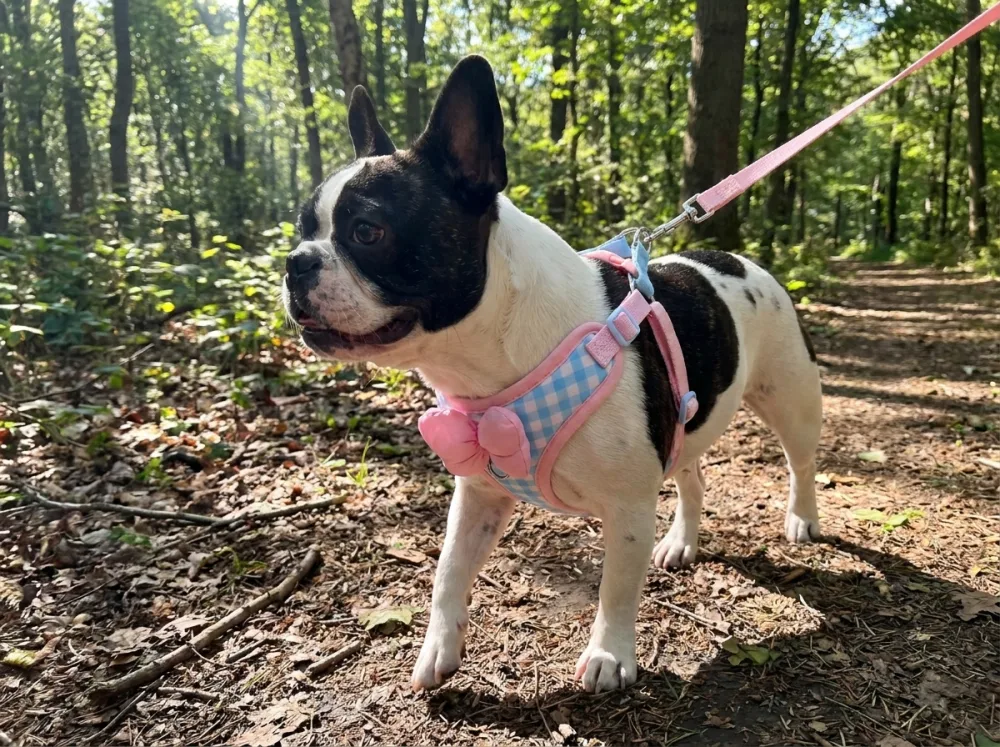
The leash clips to the top of the harness, on his back behind the neck. Two silver D-rings sit there side by side. The leash has a metal snap hook, and it goes onto those rings.
Here is what that means on a walk. The pull comes from above his shoulders and runs in a straight line back to your hand. Nothing on this harness steers him.
A ring on the chest works differently. It sits at the breastbone, so a hard pull swings his front end toward you. This set has no ring there. The small ring under the bow is for a name tag and nothing else.
| Ring | Where | On this set | What it does |
|---|---|---|---|
| Leash rings | Top of the back | 2 | Pull runs straight back along the leash |
| Tag ring | Under the bow | 1 | Holds a name tag, not the leash |
| Front leash ring | At the breastbone | 0 | Would turn him toward you on a pull |
That makes this a back-ring harness. It is honest work for a dog who walks beside you. If he hauls you down the street, this is not the set. A ring on the chest is what turns a hauler, and our front-clip harness has one.
“The harness tends to pull and twist to the side a lot… it's adjusted as best as possible.” That is an owner describing a harness that will not sit straight.
One possible reason is dull. The straps on the left are longer than the straps on the right. The panel drifts toward the short side, and every pull makes it worse.
This set has four sliders, one at each corner of the chest panel. Set them once, with him standing still on a floor that is not slippery. Make the left side match the right side. Then check that the panel sits in the middle of his breastbone.
After that, the daily work is one buckle. It is a single plastic buckle on top of his back, joining the two straps that run up to the rings. Click it shut and listen for the click.
Now slide two fingers under any strap. They should go in easily and come out with a small tug. If fur bunches up under a strap, let the slider out a little.
A Frenchie is broad in the chest and thick in the neck, so look at the Neck column too. The neck opening adjusts from 45 to 54 cm on the XL, from 40 to 45 cm on the L and from 32 to 40 cm on the M. The chest number still decides the size.
“She was just stubbornly sitting and wouldn't move.” An owner wrote that about her dog and a harness. Some dogs do that. Something new is on their body, and they stop.
So do not make the first try a walk. On day one, stay indoors, no leash. Put the harness on for five minutes at snack time. Click the buckle, give a treat, and take it off before he gets bored.
On day two, make it ten minutes. Clip the leash on and hold the handle while he walks around the room. On day three, go to the door, then to the sidewalk in front of the house. Stop while he still wants more.
Take the harness off when you are not walking him. A bow and loose strap ends can catch on furniture and crate bars.
A harness is right when it is right on the tenth walk, not only in the hallway. Look at three things at three moments. Thirty seconds each time is enough.
After the first walk, put your hand in the fur behind his front legs. Is it flat, damp or bunched? Is the panel still in the middle of his chest, or has it slid toward one leg? If it slid, one side is longer than the other. Reset the sliders.
After the third walk, look at the buckle and the sliders. Has a slider crept and let a strap out? Click the buckle shut, then tug the two straps apart. It should stay closed.
After the tenth walk, part the fur behind his front legs and look at the skin. Compare it with the skin on his belly. If you see redness, a bare patch or a sore, stop using the harness and show your vet. Do not decide what it is yourself.
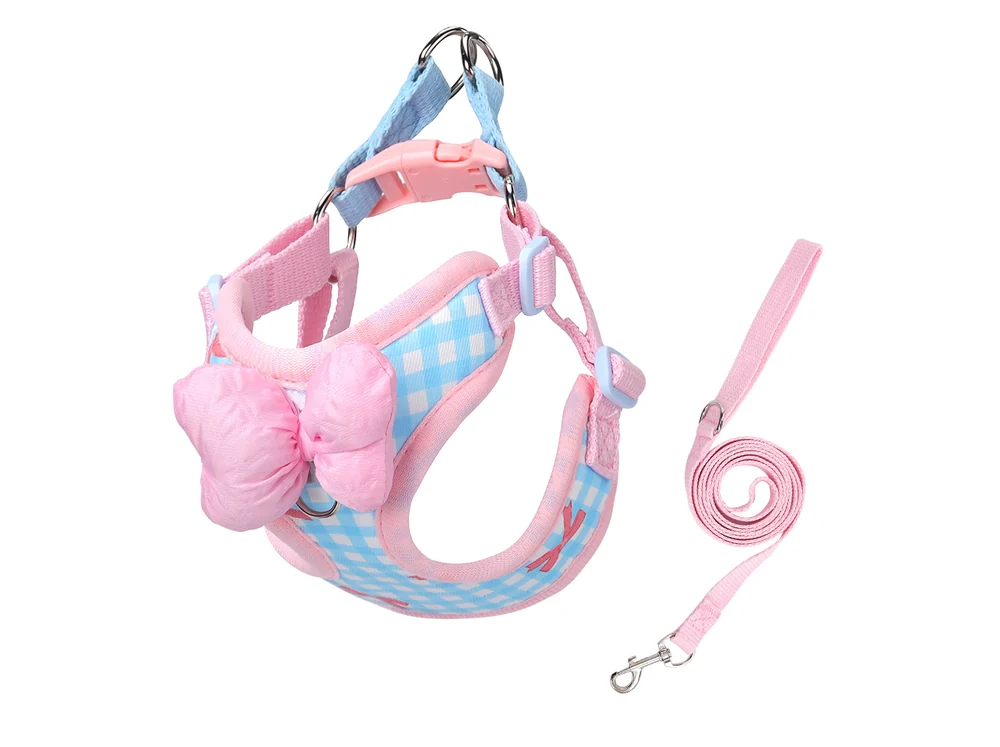
The check is printed on the fabric, and each color has its own bow and its own leash color. This is what each one looks like laid flat.
| Color | Check | Bow | Leash |
|---|---|---|---|
| Pink | Pink and white | Yellow | Cream |
| Blue | Sky blue and white | Pink | Pink |
| Green | Mint green and white | Pale yellow | Cream |
| Purple | Lilac and white | Cream | Cream |
| Red | Red and white | Pale blue | Pale blue |
Pick the size first and the color last. The size is the same in all five, and the color does not change what fits him.
The leash is a flat strap in the trim color. It has a loop handle at one end and a metal snap hook at the other. At the base of the handle sits a small metal ring, there for hanging a waste-bag holder.
| Part | What it is | How many |
|---|---|---|
| Chest panel | Printed twill fabric, mesh lining, soft rolled edge | 1 |
| Bow | Puffed fabric bow on the panel | 1 |
| Tag ring | Small metal ring under the bow | 1 |
| Leash rings | Metal D-rings on top of the back | 2 |
| Buckle | Plastic, on top of the back | 1 |
| Sliders | One at each corner of the chest panel | 4 |
| Leash | Flat strap, loop handle with metal ring, metal snap hook | 1 |
The harness alone weighs 80 g in the M, 82 g in the L and 87 g in the XL. That is 2.8 to 3.1 oz. The straps are woven, and the fabric is polyester with a mesh lining.
Better to hear it now than to send a box back. Here is who this set is not for.
| If he… | Then |
|---|---|
| Measures over 62 cm around the chest | The XL does not close that wide |
| Weighs more than 14 kg (31 lb) | He is above the XL |
| Is under 3.5 kg, or under 43 cm around the chest | He is below the M |
| Hauls you down the street | He needs a ring on the chest |
| Needs a grab handle for stairs or lifting | This set has no handle |
| Rides in the car in a harness | This is a walking harness, not a car restraint |
If none of that is your dog, tape him flat and snug and read that number in the table as it stands.
Plan on 14 days. Your harness is pulled off the shelf, checked, packed and handed to the carrier — then it travels to you. When carriers are swamped, a busy week before Christmas or a storm across half the country, it can take a few days more.
Shipping is free on every order. No minimum and no handling fee, and duty and import tax are included too — the price you see is the price you pay, with nothing to settle at the door.
A tracking number appears on our tracking page the day your parcel leaves the warehouse. Before that there is nothing to track, so we show you the stage instead.
If day 14 passes and nothing has moved, email hello@frenchieharness.com with your order number. We will chase the carrier and tell you what we find.
A Frenchie’s chest decides the size here, not his weight. Two dogs at the same weight can be five centimetres apart around the ribs, so measure him.
| Size | Neck | Chest | Fits |
|---|---|---|---|
| M | 32–40 cm / 12.6–15.7″ | 43–51 cm / 16.9–20.1″ | Puppies |
| L | 40–45 cm / 15.7–17.7″ | 50–56 cm / 19.7–22.0″ | Smaller adults |
| XL | 45–54 cm / 17.7–21.3″ | 54–62 cm / 21.3–24.4″ | Most adult Frenchies |
Tape his chest just behind the front legs, flat and snug, and find that number in the table as it reads. This set closes at 62 cm at the widest, so a very broad adult will be outside it.
Measure snug, straight off the tape. Do not add centimetres for slack — the chart already has it.
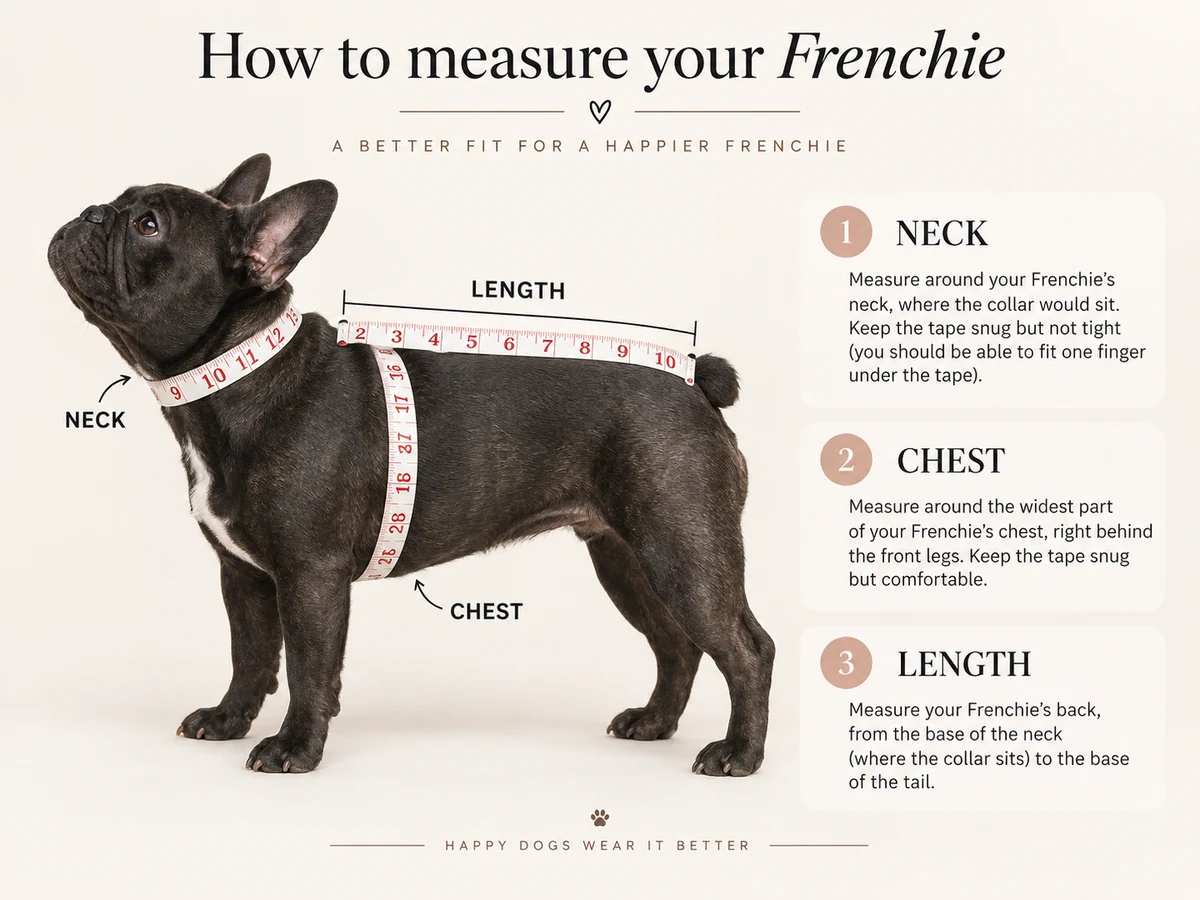
No tape at home? Use a shoelace, mark it, then hold it against a ruler. If his number falls in the gap between two sizes, take the larger one, because the smaller one stops short of him. If two sizes both cover his number, take the one where it sits farther from the edge of its range: that strap has room to tighten and to let out. If it sits exactly on the line where one size ends and the next begins, take the larger, because a harness can be taken in but not let out.
You have 30 days from delivery to send an item back. It has to be unused and in the condition it arrived in, with the tags on.
Return postage is yours. We do not send a prepaid label. If we sent the wrong item or it arrived damaged, that one is on us — postage included.
Email hello@frenchieharness.com with your order number to start one. You get the return address by reply, usually the same working day. Do not send anything back before you have it.
Once your parcel reaches us we approve the refund within a working day or two; your bank then posts it back within 5–7 working days.
Reviews are for verified buyers only. Enter your order number so we can confirm your purchase.
Your review was received — we really appreciate you taking the time.
Pick his size and it goes straight in the cart.
 Frenchie Harness